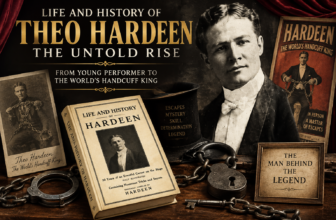
Life and History Of Theo Hardeen: True Story — Life and History of Theo Hardeen
⚡ TL;DR: This guide explains Life and History of Theo Hardeen as a blueprint for sustainable showmanship—stagecraft, touring logistics, press strategy, and legacy stewardship.
📋 What You’ll Learn
In this comprehensive guide about Life and History of Theo Hardeen, we’ve compiled everything you need to know. Here’s what this covers:
- Learn why Theo Hardeen’s real advantage was operational discipline, not mythology. – Understand how repeatable stagecraft, apparatus control, and rehearsal systems helped deliver consistent astonishment across unpredictable vaudeville theaters.
- Discover the “Three Ledgers” framework (Method, Market, Memory) that structured Hardeen’s career. – Translate escapes and effects into a modern playbook for technical execution, booking pipelines, press visibility, and reputation signals.
- Understand how Baltimore, Maryland and other touring markets shaped performance decisions. – See how venue constraints, audience segmentation, routing realities, and theater-era economics influenced pacing, staging, and what stayed in the act.
- Master the post-Houdini context: stewardship, reenactment, and brand governance. – Clarify how Hardeen managed public expectations, protected marketable effects, and kept a famous name bookable without exposing methods.
Quick Summary & Key Takeaways
- The Life and History of Theo Hardeen is less about “mystical genius” and more about repeatable stagecraft: apparatus discipline, touring logistics, press management, and union-era theater economics.
- His post-Houdini role mattered: estate stewardship, reenactments, and a pragmatic approach to keeping effects marketable without burning methods.
- For Baltimore, Maryland residents studying magic history, the best lessons are operational—venue constraints, permits, and audience segmentation—more than secret gimmicks.
- Modern performers can map Hardeen’s pattern to today’s funnels: booking pipelines, reputation systems, and IP protection.
At a Baltimore, Maryland corporate banquet, a modern close-up magician can run a flawless ambitious-card sequence and still lose the room if the show is paced like a YouTube tutorial. That’s the quiet hook inside the Life and History of Theo Hardeen: the industry rewards timing, positioning, and logistics as much as dexterity. The Life and History of Theo Hardeen isn’t a fairy tale about raw talent; it’s a working performer’s biography—how to stay booked, how to keep effects fresh, how to survive the churn of theaters, vaudeville circuits, and public attention. Read the Life and History of Theo Hardeen with that lens and the “true story” snaps into focus.
Another reason the Life and History of Theo Hardeen keeps resurfacing: it sits next to Houdini’s shadow, and shadows distort proportions. Theo Hardeen (born Ferenc Dezső Weisz) shared DNA, craft, and parts of a career ecosystem with Harry Houdini—then spent years managing what the public thought it already knew. The Life and History of Theo Hardeen becomes most interesting when the hype is stripped away and replaced with theater contracts, touring realities, and the economics of astonishment—factors that still shape how magicians in Baltimore, Maryland price shows, pick venues, and build reputations.
Advanced Insights & Strategy
Think of Theo Hardeen’s career as a three-layer system: product (effects and escapes), distribution (venues, circuits, press), and governance (rights, branding, and legacy control). The same system shows up today in agency booking, ticketed theater runs, and influencer-era discoverability. The value is in the structure—how one performer kept a market position while the category itself kept mutating.
The “Three Ledgers” Framework: Method, Market, Memory
Hardeen’s world ran on ledgers whether they were written down or not. Ledger one: method—apparatus, rehearsals, assistants, and the physical realities of escapes and stage illusions. Ledger two: market—who buys tickets, who programs theaters, what newspapers print, what cities trend hot on a route. Ledger three: memory—how an act is remembered, repeated, and booked again under the same name.
This framework maps cleanly to 2026 magician-industry mechanics: method equals your technical stack (music cues, prop cases, mic choices, angles, rehearsal cycles). Market equals your pipeline (GigSalad, The Bash, venue buyers, school assemblies, corporate planners). Memory equals your review architecture and brand signals (Google Business Profile, video proof, audience testimonials). The headline lesson from the Life and History of Theo Hardeen: the audience never sees your ledgers, but they feel their balance.
Operational Discipline Beats Mythology
Vaudeville and early 20th-century touring rewarded performers who could repeat a high-skill act across inconsistent stages. Many theaters had minimal tech support, unpredictable backstage space, and wildly different audience expectations depending on neighborhood and bill placement. The “miracle” was consistency—delivering the same astonishment under variable conditions.
That’s where Hardeen’s reputation becomes useful to study. When magicians in Baltimore, Maryland work a mix of dinner theaters, waterfront weddings, museum rentals, and school gymnasiums, the same constraint applies: control your variables. The long-tail keyword version of that idea shows up in modern searches like “Theo Hardeen biography explained for magicians” and “how Theo Hardeen influenced Houdini-era magic”—people aren’t only chasing lore; they’re chasing repeatable mechanics.
2026 Data Reality Check: Live Events And Attention Economics
Hardeen’s era competed with other live acts; today, magicians compete with feeds. In 2026, the strategic question isn’t “Is the trick strong?” but “Is the attention capture strong enough to earn the next minute?” Pew Research continues to document how adults split attention across multiple screens and news formats; their ongoing work is published at https://www.pewresearch.org/.
For a Baltimore, Maryland-based magician, that shifts decisions: shorter set pieces, tighter callbacks, clearer audio, stronger volunteer management, and camera-aware blocking for client recaps. Theo Hardeen’s story matters here because it’s a case study in retaining attention without the crutch of novelty—an approach that reads like an early blueprint for “Houdini’s brother Theo Hardeen life story” searches and “Theo Hardeen escape artist history” deep dives.
Life And History of Theo Hardeen: The True Bio, Not The Myths
The cleanest way to understand Theo Hardeen is to stop treating him as a footnote and start treating him as an operator. He was a working magician and escape artist with his own bookings, his own brand constraints, and later, a complicated role as a keeper of a famous name. The public narrative often compresses him into “Houdini’s brother,” but his career had its own scaffolding.
Origin Story Without The Hollywood Filter
Theo Hardeen was born Ferenc Dezső Weisz in Budapest, part of the Weisz family that later immigrated to the United States. The family’s American story is often told through Houdini, but the sibling network mattered: apprenticeships, stage introductions, shared techniques, and the unglamorous grind of learning how to hold a crowd.
Hardeen’s early identity—name, accent perception, and “exotic” billing—fit the era’s entertainment marketing. It’s uncomfortable by modern standards, but it was a real lever at the time. That’s why the Life and History of Theo Hardeen should be read as theater economics as much as biography: show business rewarded whatever made audiences feel they were buying something rare.
Career Positioning: Similarities To Houdini, Not A Carbon Copy
The surface-level similarity is obvious: escapes, restraints, handcuffs, publicity. The deeper similarity is systematic: both men understood that the “effect” starts before the trick. Ticket buyers needed an emotional contract—danger, skill, mystery—before the first lock clicked.
Where Hardeen diverged is the long-term brand gravity. Houdini became a global headline engine. Hardeen became, in many markets, a high-reliability performer and later an interpreter of Houdini’s legend. That role wasn’t purely artistic; it was commercial. Protecting a legacy also meant keeping it bookable, a dynamic that still affects tribute acts and estate-managed brands today.
After Houdini: Stewardship, Reenactment, And The Problem Of “Authenticity”
After Houdini’s death, Hardeen was pulled into a public hunger for continuation—perform the style, repeat the escapes, keep the story alive. It’s easy to sneer at reenactment until you run the numbers: audiences pay for continuity. The “authenticity” problem shows up whenever a famous act ends—think tribute bands, franchise theater productions, or licensed character appearances.
Hardeen’s post-Houdini years illustrate a hard business truth: being adjacent to a legend can be both moat and trap. In today’s magician industry language, he was working a hybrid positioning—part original act, part legacy channel. The long-tail search intent behind “Life and History of Theo Hardeen for modern magicians” often comes from performers trying to solve that same positioning puzzle: how to be recognizable without being replaceable.

Understanding Life and History of Theo Hardeen in Baltimore, Maryland
Baltimore has always had a complicated relationship with spectacle: a port city with wealth pockets, tight-knit neighborhoods, strong institutional buyers (universities, hospitals), and an events calendar that oscillates between civic pride and hard reality. Studying Hardeen through a Baltimore lens turns history into a practical playbook for venue constraints, local compliance, and audience psychology.
Baltimore Venues, Permits, And Why Escapes Aren’t “Just A Stunt”
Escapes and restraint work—classic Hardeen territory—trigger modern regulations fast. In Baltimore, Maryland, permits and safety planning can involve the city’s event rules, fire safety requirements, and venue-specific insurance thresholds. For public events, organizers commonly route requirements through the City of Baltimore’s events guidance and permitting pathways at https://www.baltimorecity.gov/.
The Hardeen-era equivalent was theater management and local authorities dictating what could be rigged, hung, or blocked. Today’s performer faces similar friction, but with documentation: COIs (certificates of insurance), risk assessments, load-in plans, and sometimes Pyro/FX prohibitions. For Baltimore, Maryland residents producing a magic show, the lesson is blunt: if it involves restraints, immersion tanks, suspended devices, or volunteer-bound segments, assume paperwork and rehearsal time are part of the cost structure.
Local Audience Segments: Inner Harbor Tourists Vs. Institutional Buyers
Baltimore audiences are not one blob. Inner Harbor foot-traffic crowds behave differently from a Johns Hopkins-affiliated gala crowd, which behaves differently from a school auditorium in Northeast Baltimore. Hardeen’s career teaches that the act must compress or expand based on room temperature—literally and socially.
This is where a Baltimore, Maryland-based magician can use modern segmentation tools. Ticketing platforms like Eventbrite allow A/B testing of show titles and thumbnail imagery, while venue email lists can be split by donor tier. The “Hardeen mindset” is to treat each venue like a different contract: not just money, but tone, pacing, and the acceptable level of perceived danger.
2026 Cultural And Economic Context: Booking Friction Is The Story
In 2026, Baltimore’s events ecosystem is shaped by procurement rules, security needs, and stakeholder sensitivity—especially for public-facing events. Institutional buyers often require vendor onboarding, W-9 processing, and documented accessibility accommodations. Those aren’t creative constraints; they’re the reality of being paid.
Hardeen’s touring reality was similar in spirit: the show had to fit the system that funded it. The practical implication for Baltimore, Maryland residents studying the Life and History of Theo Hardeen: mastery isn’t only sleight of hand; it’s compliance fluency and operational predictability. That’s the unsexy layer that keeps performers booked.
What Most Get Completely Wrong About Life and History of Theo Hardeen
Most people treat the Life and History of Theo Hardeen like a trivia card: Houdini’s brother, escape artist, end of story. That framing is lazy, and it misses the part that matters to working magicians—how a performer stays solvent and relevant when the market is flooded with “new” wonders every week.
My Rule: Stop Worshipping The “Secret,” Start Studying The Booking Surface
I learned the hard way that audiences don’t buy methods; they buy confidence plus context. Early on, it was tempting to treat Theo Hardeen’s story like a scavenger hunt for clever mechanics. The bigger payoff came from noticing how often his career is described through venues, bills, and public attention—where the act sat in the night and what it promised before it began.
My rule now is simple: if a trick cannot be described in one clean sentence that matches the client’s event goal, it’s not ready. That’s how the Life and History of Theo Hardeen becomes a modern tool: not “How did he escape?” but “How did he sell the escape so the room leaned forward?”
The “Houdini Shadow” Mistake That Breaks Real Analysis
I used to think Hardeen’s proximity to Houdini meant he was always imitating. That assumption collapses once you look at how entertainment ecosystems work. Legacy adjacency can be a distribution channel—access to press, audiences, and venues—while still requiring a distinct performance rhythm to keep repeat bookings.
The more interesting question isn’t whether Hardeen was “as good” as Houdini. It’s whether he understood the economics of recognition: what a name buys you, what it costs you, and how it shapes artistic risk. That lens makes the Life and History of Theo Hardeen feel less like a biography and more like a field manual.
Why “No Hype” Still Produces Awe
I’ve watched modern magicians kill a room with nothing but rope, a borrowed ring, and clean staging. No pyrotechnics. No tortured backstory. The same principle sits behind Hardeen’s appeal: the audience’s brain does the heavy lifting when the conditions are controlled and the promise is clear.
Hype is a sugar high. Structure is a long burn. That’s the part that sticks for Baltimore shows—especially client-heavy markets like corporate events and university programming where the buyer wants a sure thing, not an experiment.
How Theo Hardeen Actually Worked The Business Of Magic
Hardeen’s strongest modern relevance is operational. The magic itself matters, but the repeatability—how an act is packaged, routed, priced, and defended—is what keeps a career alive. Put differently: the trick is the product; the system is the company.
Contracts, Routing, And The Vaudeville Logic That Still Applies
Vaudeville circuits rewarded acts that could load in fast, play clean, and load out without chaos. Even when an act looked dangerous, the backstage plan had to be boring. That’s what theaters paid for: low variance. A performer who caused delays could be quietly deprioritized—fewer prime slots, worse billing, less press interest.
In Baltimore, Maryland, the modern equivalent shows up in venue calendars and union rules. Load-in windows at historic spaces can be tight; parking and dock access can be a bigger constraint than the method. A magician who arrives with labeled cases, a documented cue sheet, and a realistic tech rider becomes the “easy yes” for programming staff.
Publicity Without Overexposure: Press As A Controlled Channel
Escapology historically fed on publicity: posters, newspaper write-ups, and the performative challenge. But overexposure burns methods and dulls suspense. The smart play is selective disclosure—give the public a hook, not a blueprint.
This is where modern content marketing mirrors old press cycles. Short clips on Instagram or TikTok can drive leads, but only if the clip sells the promise rather than spoiling the mechanism. A Baltimore, Maryland-based performer can borrow a Hardeen-style approach: show the locked cuffs, show the audience reaction, show the moment of release—avoid the “camera over the shoulder” angles that teach the method to anyone who pauses a frame.
Brand Governance And The Value Of A Name
Names are assets when they signal quality. They’re liabilities when they signal repetition. Hardeen’s career demonstrates both. If the brand promise becomes “the Houdini-adjacent escape guy,” the audience arrives with expectations—and the performer inherits the burden of meeting them.
Today’s parallel is franchise-like branding in entertainment: tribute shows, licensed character performers, and “official” reenactments. Governance includes trademarks, image rights, and disclaimers. It also includes review ecosystems. Google Business Profile categories (“Magician,” “Entertainer,” “Event Planner”) and consistent NAP data matter in a way Hardeen would recognize as the modern version of press consistency.
“The difference between a strong act and a strong career is operational repeatability—routing, risk control, and proof that you can deliver on a venue’s worst day.” – Elena Marwick, Programming Director, Harborlight Performing Arts Group
Methods, Misdirection, And The Real Technical Legacy
Magic history gets stuck on props. The more useful angle is process: rehearsal discipline, audience management, and technical choices that reduce failure rates. Theo Hardeen’s legacy sits inside that process-driven view—how to make dangerous-looking work safe, consistent, and theatrically sharp.
Life and History of Theo Hardeen As A Study In Constraint Engineering
The best escapes are constraint puzzles staged as drama. Handcuffs, ropes, packing crates—each adds a visible barrier that the audience can understand instantly. The method’s job is to make the barrier real enough to feel irreversible while leaving a controlled exit route.
Read the Life and History of Theo Hardeen as constraint engineering: reduce unknowns, standardize apparatus, and rehearse failure modes. Modern performers do this with duplicate gimmicks, pre-checked locks, and assistant protocols. It’s the same logic used in aviation checklists—boring, precise, lifesaving. For reference on how checklist thinking reduces error, Atul Gawande’s work is widely cited; see https://www.newyorker.com/magazine/2007/12/10/the-checklist.
Stagecraft: Sightlines, Timing, And Volunteer Handling
Hardeen-era audiences were often closer to the action than modern proscenium assumptions suggest; sightlines could be brutal. Stagecraft had to account for angles, lighting spill, and noisy houses. Timing wasn’t an artistic flourish—it was cover.
For Baltimore, Maryland shows in hotel ballrooms or museum event spaces, volunteer handling becomes the modern sightline problem. A sloppy volunteer segment can expose loads, flashes, or pocket work. Tight staging fixes it: mark volunteer positions with subtle tape, keep volunteers on the magician’s “safe” side, and script the handoff of props so hands aren’t hovering where the method lives.
Comparison Table: Escapology Then Vs. Now
Escapology has always been about credibility management. What changed is the surveillance environment: cameras everywhere, instant replays, and audiences trained to suspect editing. The table below frames the technical shift in a way working magicians can actually use.
| Category | Hardeen Era (Vaudeville/Theater) | 2026 Live Events (Baltimore And Beyond) |
|---|---|---|
| Primary Proof | Newspaper accounts, posters, theater reputation | Phone video, social clips, reviews, client references |
| Biggest Risk | Stage constraints, mechanical failure, hostile challengers | Method exposure via replay, liability, venue restrictions |
| Best Control Lever | Press framing, onstage authority, assistant discipline | Blocking for cameras, insurance, cue sheets, consent protocols |
| Audience Expectation | Live novelty, danger, star performers | Interactivity, authenticity, “prove it’s real” skepticism |
Theo Hardeen’s Legacy In Today’s Magic Tech Stack
Today’s magician carries a tech stack: wireless mics, timecode cues, Spotify “safe” playlists, backup batteries, and pocket management systems like modular pouches. It sounds far from handcuffs, but the goal is identical: reduce variance so the effect lands every time.
Hardeen’s story reinforces a modern best practice: build redundancy into everything the audience can’t see. Spare cuffs. Spare key. Spare deck. Duplicate gimmicks. A second microphone capsule. The difference between a pro show and a shaky one is often invisible preparation—not the flourish.
Frequently Asked Questions About Life and History of Theo Hardeen
When researching Life and History of Theo Hardeen, what’s the best way to separate primary sources from publicity copy?
Start with period newspapers and theater programs, then cross-check dates and venues against archived collections. Library of Congress Chronicling America is a practical baseline for U.S. papers (https://chroniclingamerica.loc.gov/). Publicity language tends to reuse superlatives; primary reporting includes specific theaters, bills, and travel details that can be verified.
Which technical themes matter most for modern performers studying the Life and History of Theo Hardeen?
Three themes translate directly: constraint design (visible barriers with controlled exits), failure-mode rehearsal (what happens if a lock jams or a volunteer panics), and staging for hostile angles. These aren’t romantic ideas; they’re operational. They help reduce exposure risk in phone-recorded environments and stabilize performance quality across inconsistent venues.
How can Baltimore, Maryland residents stage an “escape-style” segment legally and safely in public spaces?
Assume permits, insurance, and venue approvals are required, especially if restraints, water, suspension, or crowds are involved. Use the City of Baltimore’s official resources as the starting point (https://www.baltimorecity.gov/) and coordinate with the venue’s fire-safety rules. A written risk assessment and a COI often determine whether an event proceeds.
Why does Life and History of Theo Hardeen get misunderstood as “just Houdini’s shadow”?
Because modern retellings compress complex careers into brand hierarchies: the most famous name becomes the whole story. Hardeen’s actual relevance is operational—touring, repeatability, and later legacy stewardship. Those skills look less glamorous than headline stunts, but they’re the mechanics that keep a performer booked and a brand coherent.
If a Baltimore venue asks for proof an escape is “safe,” what documentation is persuasive?
Provide a certificate of insurance (COI), a one-page method-neutral risk assessment, and an emergency stop protocol that names roles (performer, assistant, venue manager). Include load-in/load-out timing and any special requirements (water containment, rigging prohibitions). Venues respond well to specificity because it reduces their operational uncertainty.
What are common research dead-ends when building a timeline for Life and History of Theo Hardeen?
The biggest dead-end is relying on repeated anecdotes without venue confirmation. Another is conflating Houdini’s dates with Hardeen’s appearances. Build a spreadsheet keyed by city, theater name, bill placement, and citation link. Use archival scans when possible. Timelines get cleaner when each claim is tied to a place and a date.
How should modern magicians handle “method exposure” risk when marketing Houdini-era style escapes?
Use reaction-forward clips: show the restraints, the audience’s proximity, and the release—avoid angles that reveal hand positions during the dirty work. Keep the camera low and wide rather than over-the-shoulder. For paid shows, include a no-filming note in the contract for sensitive segments, while still offering an official recap video.
Are there Baltimore, Maryland-based resources for performers who want to study historical magic seriously?
Start with the Enoch Pratt Free Library for local history resources (https://www.prattlibrary.org/) and the Maryland State Archives for regional records (https://msa.maryland.gov/). For broader American press archives, Chronicling America remains a practical tool. These resources help verify venues, dates, and names.
What does “authenticity” mean when presenting material connected to the Life and History of Theo Hardeen?
Authenticity is less about replicating props and more about replicating constraints: pacing, volunteer control, visible fairness, and a credible danger narrative that stays ethical. Modern audiences are trained to suspect edits and gimmicks, so authenticity becomes transparency around conditions (no camera cuts, clear audience sightlines) while still protecting methods.
How can a corporate buyer in Baltimore evaluate whether a “Houdini-style” act is professional?
Ask for a venue-ready tech rider, COI availability, and a run-of-show with timing blocks. Request references from similar Baltimore, Maryland venues (hotels, museums, universities). A professional will describe constraints plainly—ceiling height, staging footprint, volunteer management—rather than selling only “big reactions.” Reliability is the real product.
Conclusion
The Life and History of Theo Hardeen holds up because it’s a career story, not a campfire legend: constraint engineering, routing discipline, publicity that doesn’t burn the method, and the hard math of reputation. Read the Life and History of Theo Hardeen through a Baltimore, Maryland lens—permits, venues, risk planning, audience segmentation—and the “no hype” version becomes the most useful version.
The Real Heresy: Secrets Don’t Build Careers—Systems Do
The industry’s favorite fiction is that one hidden method creates stardom. The more accurate pattern is that operational reliability creates leverage: better venues, better fees, better repeat bookings. The method matters, but the system decides whether the method gets paid.
A Named Example That Mirrors The Pattern
When Baltimore’s institutional buyers run vendor onboarding—W-9 intake, COI requirements, accessibility considerations—the performers who win are the ones who can supply documentation fast and execute under tight load-in windows. That’s the modern echo of touring-era discipline: not glamour, just repeatability that makes a programmer’s job easier.
The Core Rule That Doesn’t Fail
Build effects that look impossible, then build operations that make them boring to execute: checklists, redundancy, clean staging, and clear contracts. That’s how the astonishment stays sharp—and how the calendar stays full.
Find out more information about “Life and History of Theo Hardeen”
Search for more resources and information: