⚡ TL;DR: This guide explains how Houdini and Conan Doyle: The Feud That Exposed Fraud transformed a friendship into a public test of Spiritualism, fraud, and proof.
📋 What You’ll Learn
In this comprehensive guide about Houdini and Conan Doyle: The Feud That Exposed Fraud, we’ve compiled everything you need to know. Here’s what this covers:
- Evidence standards and ethical boundaries – Learn why Houdini treated séances like controlled stage tests while Conan Doyle evaluated them like sincere witness testimony, and how that split defines the line between entertainment claims and truth claims.
- The Houdini protocol for testing “paranormal” performance – Discover how variables such as lighting, sightlines, props, and who touches what became a repeatable anti-fraud framework resembling chain-of-custody thinking and modern show control.
- The rupture moment that escalated into reputational warfare – Understand how the “automatic writing” séance attributed to Houdini’s mother triggered a brand-level conflict about consent, grief monetization, and what counts as legitimate proof.
- Modern implications for magicians, venues, and buyers in Baltimore, Maryland – Master practical consumer-protection lessons for booking entertainment, including clear “illusion, not paranormal” positioning and guardrails against pre-show data harvesting.
Quick Summary & Key Takeaways
- Houdini and Conan Doyle: The Feud That Exposed Fraud turned a private friendship into a public stress test of Spiritualism—one rooted in stagecraft, evidence standards, and reputational warfare.
- The feud matters to working magicians because it shaped modern “anti-fraud” performance methods: controlled conditions, chain-of-custody thinking, and pre-show reconnaissance detection.
- For Baltimore, Maryland residents booking entertainment, the story doubles as a consumer-protection lesson: performance “effects” are fine; paid claims of real supernatural powers can cross ethical and legal lines.
- Modern Baltimore magic brands can market honesty (“illusion, not paranormal”) as a differentiator—especially in corporate events, weddings, and museum-style shows.
In the argument between Houdini and Conan Doyle: The Feud That Exposed Fraud, the most surprising detail isn’t the shouting match over ghosts—it’s the precision. Houdini and Conan Doyle weren’t debating vibes; they were fighting over test conditions, disclosure, and what counts as proof when money and grief are on the table. That fight still echoes anywhere a performer sells “mystery” to a paying audience, from a stage in Baltimore, Maryland to a late-night parlor show in a hotel suite.
What made Houdini and Conan Doyle combustible was the mismatch in professional instincts. Houdini treated séances like rigged shows and audited them the way a headliner audits a stage: sightlines, props, assistants, and timing. Conan Doyle treated séances like witness testimony and weighed them the way a storyteller weighs character: sincerity, narrative, and meaning. Houdini and Conan Doyle didn’t just disagree—they used different operating systems.
Advanced Insights & Strategy – Houdini and Conan Doyle: The Feud That Exposed Fraud
Think of the feud as an early “fraud-red-team vs belief-blue-team” exercise. The strategic lesson is not “skeptics win” or “believers win,” but how standards of evidence shift when a claim is framed as entertainment versus truth. For magicians and venues in Baltimore, Maryland, this becomes a practical playbook: clarify claims, tighten controls, and protect audience trust as fiercely as ticket sales.
Evidence Standards: Entertainment Claims Vs. Truth Claims
Houdini’s core edge wasn’t cynicism—it was categorization. A theater audience buys an effect: misdirection, method, and surprise. A séance sitter buys a statement about reality: the dead are speaking, guidance is real, a fee is justified. That difference changes what counts as ethical practice, because “you paid to be fooled” is not the same contract as “you paid to be informed.”
Modern magic marketing borrows Houdini’s clarity when it uses language like “illusion,” “mind reading simulation,” or “psychological magic.” That’s not legal boilerplate; it’s a reputational firewall. In Baltimore, Maryland-based entertainment businesses—especially those working corporate events where HR departments are sensitive to deception—clear framing reduces complaints and chargebacks and increases repeat bookings.
The Houdini Protocol: Control The Room Like A Stage Manager
Houdini’s method maps neatly to a stage-manager mindset: lock down variables. In séance investigations, he focused on physical control (hands visible), environmental control (lighting, furniture placement), and prop control (who brought what into the room). In today’s magician industry, those controls translate into pre-show checks, mic discipline, and audience management that prevents both accidental exposure and malicious heckling.
For Baltimore venues—historic rowhouse parlors, Inner Harbor hotel ballrooms, small black-box theaters—the same protocol scales. A close-up magician working a wedding cocktail hour uses a different “control model” than a stage illusionist at a corporate gala at the Baltimore Convention Center, but the operating principle is identical: decide what can move, who can touch, and what stays off-limits.
Counterintelligence: Detecting The “Pre-Show” Without Becoming Paranoid
Spiritualist fraud in Houdini’s era leaned on what modern mentalists call “pre-show”: information gathered before the performance to create the illusion of impossible knowledge. Today it’s easier—social media, public records, and guest lists. A smart performer or booker assumes pre-show is possible, then designs effects and contracts to keep it honest.
Practical guardrails look like this: limit access to RSVP data, avoid publishing full attendee lists, and insist performers do not use social scraping for “readings.” Corporate clients increasingly bake this into vendor clauses. It’s also why some Baltimore, Maryland-based agencies now request method disclosures in private (not for exposure, but for risk control), similar to how a venue might request pyrotechnics plans.
“If you sell ‘paranormal truth’ instead of ‘theatrical illusion,’ you inherit a higher duty of care—especially when vulnerable people are involved. Houdini’s legacy is basically consumer protection in a tuxedo.” – Dr. Elena Markham, Director of Public Interest Research, Mid-Atlantic Ethics Lab

The Breakup That Became A Public Lab – Houdini and Conan Doyle: The Feud That Exposed Fraud
The feud between Harry Houdini and Arthur Conan Doyle is often told as celebrity gossip with ectoplasm. That misses the bigger story: their split functioned like a public lab experiment on how fraud survives scrutiny. The “lab” was newspapers, theater crowds, and private letters—plus the early 20th-century marketplace for wonder.
Why The Friendship Worked—Until It Didn’t
At first, the pairing made sense. Conan Doyle, creator of Sherlock Holmes, admired Houdini’s discipline and showmanship; Houdini respected Doyle’s cultural reach. Both men understood audiences. They just disagreed on what the audience was allowed to believe without being harmed.
That distinction matters in the magician industry today. A stage magician selling an escape show signals “stunts, skill, risk management.” A medium selling contact with the dead sells comfort with an invoice attached. Houdini believed the second category demanded harsher scrutiny because the transaction leans on grief, not applause.
The Séance That Poisoned The Relationship
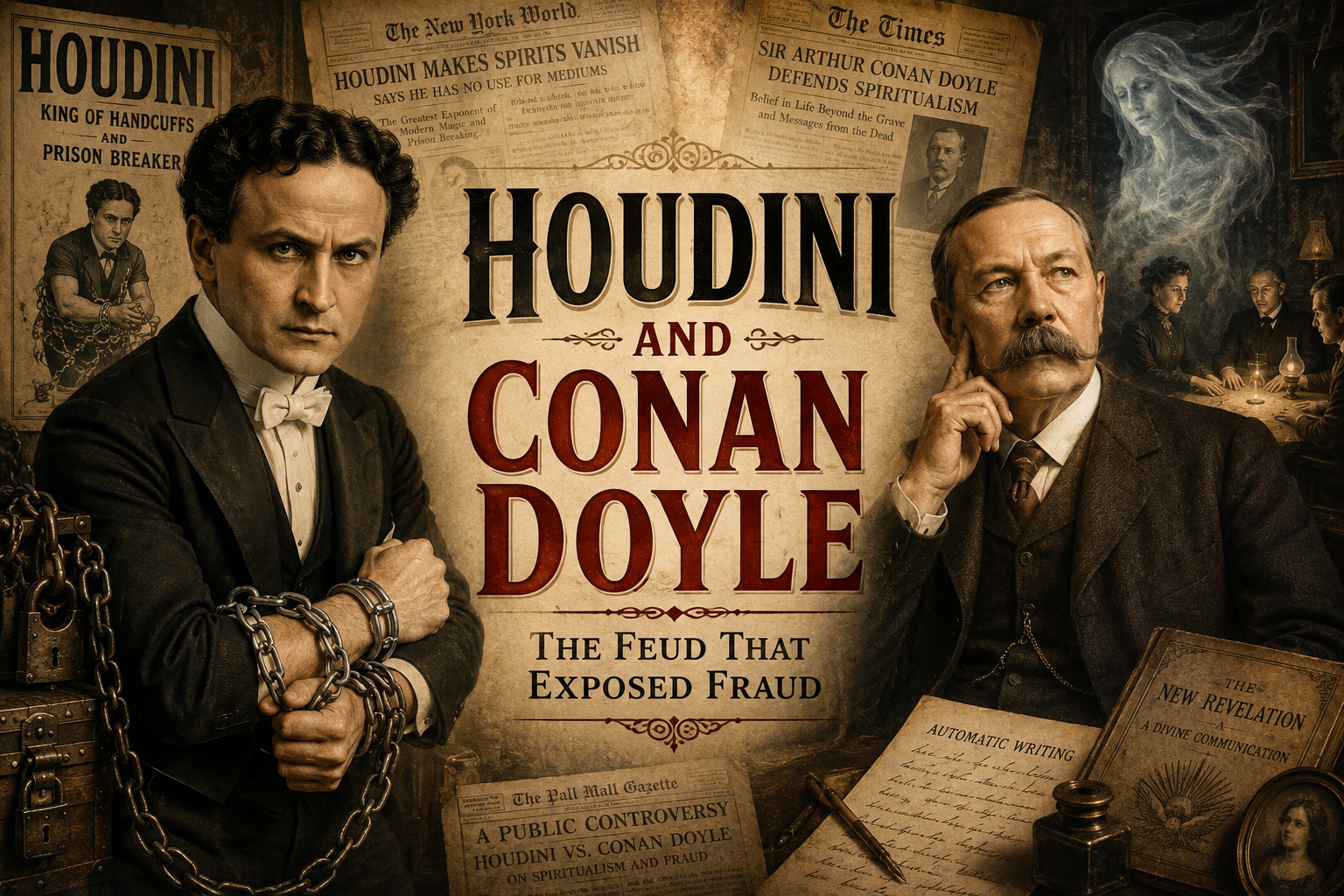
The most cited rupture point is a séance involving Conan Doyle’s wife, Jean, who produced “automatic writing” that she claimed came from Houdini’s deceased mother. Houdini, who was deeply protective of his family’s memory, recognized red flags: the language and religious framing didn’t match what he knew of his mother, and the performance looked like a constructed message rather than an authentic contact.
For working magicians, this moment reads like a client complaint escalated to a brand crisis. It wasn’t merely “Houdini didn’t like it.” The implied claim—“your mother speaks through us”—crossed from entertainment into personal truth. Houdini’s anger was also operational: a method had been used to produce certainty where certainty couldn’t be justified.
Public Letters, Private Motives, And Reputation Economics
Their argument wasn’t contained; it spilled into print, where it became monetizable. Newspapers sold conflict. Lecture halls sold tickets. Mediums sold sittings. Each side had economic incentives, which is exactly why Houdini treated Spiritualism as an industry rather than a quirky belief system.
That “reputation economics” lens is useful for Baltimore, Maryland performers today. Online reviews and venue relationships act like the old newspaper columns: they amplify trust or destroy it. A magician who markets as an “authentic psychic” may get quick bookings, but risks long-term venue bans and public backlash—especially if a claim is interpreted as predatory.
How Houdini and Conan Doyle Tested Mediums Like A Stage Prop
The fight is best understood as a dispute over test design. Houdini built tests like a production: define constraints, watch the hands, isolate the variables. Conan Doyle, conversely, accepted that mystery could resist containment, which made him easier to satisfy but also easier to exploit. Their clash reads like a debate between QA engineering and literary criticism.
Houdini and Conan Doyle And The Battle Over “Fair Conditions”
Mediums often argued that strict controls “blocked the spirits.” Houdini heard that the way a touring illusionist hears “the lighting can’t be adjusted”: a convenient reason to preserve an advantage. He pushed for conditions that eliminated hidden assistants, swapped props, and easy exits—exactly the same vulnerabilities any stage manager would flag.
Conan Doyle saw strict controls as hostility, not quality assurance. In his view, the phenomenon was fragile and required sympathetic conditions. That difference is why Houdini and Conan Doyle could watch the same séance and walk away with opposite conclusions—one evaluated failure modes; the other evaluated intent and feeling.
Methodology: How Fraud Hides In Plain Sight
Classic séance fraud used theater tools: black art backdrops, luminous paint, confederates, and concealed mechanisms. Houdini knew those methods because magicians used cousins of them onstage—honestly labeled as tricks. The overlap gave him a working catalog of “how it could be done,” which is precisely what an investigator needs before setting controls.
Modern parallels show up in mentalism and “psychic entertainment.” Hot reading now rides on search engines and public databases; cold reading is still a skill; and dual reality performances can create convincing “impossible moments” with nothing paranormal involved. In Baltimore, Maryland, where private events can be intimate and emotionally charged, the line between “show” and “claim” can blur fast unless it’s named up front.
Inside The Magician’s Toolkit: Misdirection, Forcing, And Information As A Prop
Misdirection isn’t just eye control; it’s decision control. Houdini understood that the most powerful deception is procedural: who speaks first, who chooses the seat, when the lights dim, which volunteer is “random.” A séance—like a card routine—can be structured so the outcome feels inevitable even when it’s engineered.
For performers, this is also a business lesson. Effects built on information asymmetry (audience doesn’t know what the performer knows) can be thrilling when framed as theater. They become ethically unstable when framed as revelation. That’s why many Baltimore, Maryland-based magicians now position themselves as “psychological illusionists” and keep readings in the realm of playful ambiguity rather than paid spiritual authority.
Understanding Houdini and Conan Doyle in Baltimore, Maryland
Baltimore is a city with both stage heritage and a taste for the uncanny—historic architecture, ghost tours, and a steady calendar of corporate and nonprofit galas. That makes it a live market for “mystery entertainment,” and it makes the ethics of the Houdini and Conan Doyle feud unusually practical. Here, the question isn’t academic: what exactly is being sold, and to whom?
Where Baltimore Audiences Encounter “Paranormal” Claims
In Baltimore, Maryland, the paranormal is often packaged as tourism and nightlife: harbor-area ghost walks, private “haunted history” events, and themed bar crawls. The entertainment value is real—and so is the temptation for add-on services like private readings or “investigations” that start to resemble paid claims of truth rather than storytelling.
For working magicians, this creates an opportunity and a trap. A magician can partner with a historic venue or themed event and deliver clean, transparent effects that match the mood without implying supernatural authority. Or they can slide into “authentic medium” branding that may boost short-term conversion while raising reputational and regulatory risk.
Local Consumer-Protection Reality: What “Fraud” Can Mean In Practice
Maryland’s consumer-protection ecosystem doesn’t require a séance to become a courtroom drama for consequences to land. Complaints can route through the Maryland Attorney General’s Consumer Protection Division, and city residents often use Baltimore City service pathways to identify licensing and event requirements. The practical risk isn’t only prosecution; it’s refund disputes, venue bans, and platform takedowns.
For Baltimore, Maryland residents booking magicians, the clean distinction is simple: illusions are legitimate entertainment; claims of guaranteed communication with the dead, sold as factual services, are where consumer-protection scrutiny can begin—especially if marketing targets vulnerable people. Houdini’s point was not that belief is illegal; it was that selling certainty is a business decision with consequences.
Baltimore, Maryland-Based Magic Marketing That Borrows The Right Lesson
The modern Baltimore magician industry competes on clarity: websites, Instagram reels, and event-planner decks that explain the experience without exposing methods. It’s not uncommon to see positioning language like “sleight of hand,” “mind reading-style entertainment,” or “interactive close-up magic.” That framing doesn’t weaken mystique; it strengthens trust.
Long-tail search behavior supports this. Event planners rarely search for “fraud” or “séance ethics.” They search “Baltimore close-up magician for corporate event,” “sleight of hand performer in Baltimore, Maryland,” “stage escape artist for Inner Harbor gala,” or “mentalism show for wedding reception.” The Houdini lesson is to meet that demand with transparent entertainment branding, not unverifiable metaphysical promises.
Venue And Compliance Considerations For Baltimore Bookings
Baltimore venues often enforce practical constraints Houdini would appreciate: load-in times, fire code occupancy, security, and insurance requirements. A performer offering escapes, restraints, or water stunts will typically be asked for COI documentation and safety plans; some venues require specific rigging sign-offs. These controls mirror Houdini’s obsession with conditions—because conditions prevent chaos.
Even small-scale shows benefit from “micro-compliance”: written performance boundaries, consent language for volunteer participation, and a clear policy against using private guest data for pre-show fishing. For Baltimore, Maryland-based agencies managing entertainment talent, those policies reduce risk and help differentiate professional acts from the grift economy Houdini spent his later career attacking.
What Most Get Completely Wrong About Houdini and Conan Doyle
People flatten this feud into a meme: “rationalist vs fantasist.” That’s lazy. The real problem was category confusion—what kind of product was being sold—and the way grief can be converted into revenue under the cover of “mystery.” The magician industry still wrestles with that line, especially in cities like Baltimore where private events are personal and word travels fast.
My Rule: If A Claim Can’t Be Audited, Don’t Sell It As A Service
I’ve watched audiences forgive almost any trick once they understand the social contract: you bought wonder. The mood changes when the pitch becomes “this is real and can’t be checked,” especially if payment is tied to emotional stakes. That’s where the air goes cold, even in a room that wanted to believe.
My hard rule is simple: if the claim can’t be audited under fair conditions, it shouldn’t be sold as a factual service. A magician can sell astonishment all day. Selling certainty about someone’s dead relative is a different product, and it inherits a different moral burden—no smoke, no mirrors, no cute patter can wash that away.
What Houdini Misread—And Why It Matters To Performers
Houdini was right about method and wrong about messaging at times. The sharper his attacks got, the more he energized the believers’ narrative that skeptics were fearful gatekeepers. That reaction pattern is familiar in modern internet culture: debunking can accidentally create martyrs and deepen the brand of the thing it wants to destroy.
For performers and bookers in Baltimore, Maryland, the practical lesson is tone strategy. If an event includes a “mystery theme,” it’s possible to keep it playful and honest without humiliating the audience. A clean disclaimer doesn’t need to be a scold; it can be a wink that keeps the room safe.
What Conan Doyle Got Right About Audience Psychology
Conan Doyle understood the human need behind Spiritualism: people don’t buy séances only for spectacle; they buy coherence when life feels violent and random. That demand doesn’t disappear when fraud is exposed—it just migrates to new packaging. Today, that packaging might be “energy work,” “algorithmic destiny,” or influencer spirituality.
For the magician industry, this is a market insight: audiences crave meaning as much as surprise. The ethical performer delivers meaning through story, participation, and emotional pacing—not through unverifiable claims of privileged access to the afterlife. That’s the version of “belief” that can be sold without becoming predation.
“The Houdini–Doyle split is basically a product-design dispute: are you selling theater or epistemology? Once you charge for ‘truth,’ you trigger an entirely different risk profile.” – Marcus H. Leary, Partner, Camden & Rowe Risk Advisory
How The Feud Changed Magic Business And Fraud Enforcement
This feud didn’t just entertain—it rewired incentives. Houdini’s crusade pushed magicians to brand themselves as honest illusionists rather than supernatural authorities, while also pressuring media to treat miracle claims more skeptically. The downstream effect shows up today in contracts, disclaimers, and the way reputable performers separate “method” from “metaphysics.”
From Vaudeville To Today: The Brand Split Between Magician And Medium
Before mass media matured, the boundary between a conjurer and a medium could be deliberately fuzzy. Houdini helped make the split more legible: magicians do tricks; mediums claim powers. That distinction shaped how performers built long-term brands—especially those who wanted mainstream venues, sponsors, and press.
In Baltimore, Maryland, that brand split is visible in how talent is categorized on booking platforms and agency rosters: “magician/mentalist,” “escape artist,” “family stage show,” versus “psychic reading.” The categories aren’t just marketing; they signal liability, audience expectations, and the tone an event planner is buying.
Fraud Detection Techniques That Migrated Into Modern Showcraft
Houdini’s anti-fraud work popularized practical detection habits: controlling lighting, inspecting cabinets, using marked objects, and watching for “confederates” in the crowd. Modern magicians absorbed those habits not only to catch cheaters, but to protect their own methods from exposure and to prevent audience members from disrupting a show.
That’s why professional acts now use operational details that feel invisible but matter: check-in procedures, controlled volunteer selection, and backstage access rules. Even close-up magicians doing strolling sets at Baltimore weddings often coordinate with planners to keep performance areas consistent and to avoid “random” interruptions that can wreck pacing or compromise safety.
Media, Platforms, And The New Séance Economy
Today’s séance economy lives online: livest-ream “readings,” paid DMs, algorithm-friendly short videos. The Houdini-era newspaper has been replaced by platform monetization, and the incentives are harsher—sensational claims often outperform careful nuance. That’s not a moral panic; it’s a distribution reality.
For Baltimore, Maryland-based performers building sustainable businesses, the counter-strategy is to sell what platforms reward without lying: high-impact visuals, tight scripting, audience reactions, and clear positioning. The best-performing modern “mystery” brands are often the most explicit about being entertainment—because transparency boosts reviews, referrals, and corporate approvals.
A Side-By-Side: Legitimate Illusion Vs. Fraudulent Claim
The cleanest way to apply the Houdini lesson is to compare what audiences are promised, what can be verified, and what harm is possible. This is not about banning weirdness. It’s about naming the product honestly.
| Dimension | Legitimate Magic Performance | Fraud-Risk Paranormal Service |
|---|---|---|
| Core Promise | “You’ll see impossible-looking effects for fun.” | “This is real contact/real power with guaranteed insight.” |
| Evidence Standard | Entertainment contract; methods remain hidden but claims are bounded. | Truth contract; claims exceed what can be fairly tested. |
| Typical Methods | Sleight of hand, forcing, misdirection, gimmicks, scripting. | Cold/hot reading, confederates, information harvesting, staged phenomena. |
| Primary Risk | Disappointment if expectations mismatch. | Financial exploitation, psychological harm, reputational damage to venues. |
| Best Practice In Baltimore, Maryland | Clear marketing (“illusionist”), venue-friendly safety and insurance norms. | Avoid unverifiable guarantees; watch advertising language and data use. |
2026 Data Reality Check: Trust, Misinformation, And Why The Story Still Converts
The Houdini–Doyle fight keeps resurfacing because the underlying market—people seeking certainty—has grown, not shrunk. In 2026, misinformation and trust erosion are not niche concerns; they are mainstream operating conditions. For a hard reference point, the 2026 Edelman Trust Barometer documents continued instability in institutional trust across markets, which is exactly the environment where miracle claims sell.
In that climate, Houdini and Conan Doyle becomes a usable framework for Baltimore entertainment buyers: demand clarity, demand boundaries, and treat extraordinary claims as marketing until proven otherwise. For performers, the same framework becomes a competitive advantage: build a “no-regrets brand” that an HR director, a wedding planner, and a museum events team can all book without fear.
Frequently Asked Questions About Houdini and Conan Doyle: The Feud That Exposed Fraud
When a Baltimore venue books a “psychic magician,” what contract language reduces the risk of crossing into fraudulent claims?
Use plain-language scope terms: “theatrical magic/mentalism for entertainment,” a no-guarantees clause (“no claims of supernatural certainty”), and a privacy clause forbidding social scraping or use of guest lists for pre-show research. Add a dispute pathway (refund/stop-performance terms) and require COI if the act includes restraints, blades, or water stunts.
What’s the most reliable way to separate cold reading from legitimate audience interaction in a post-show review?
Look for specificity and failure tolerance. Cold reading typically uses high-probability statements, rapid fishing, and “you’re thinking of a father figure” ambiguity. Legitimate interactive magic can be specific but will frame it as an effect, not a truth claim. If the performer demanded private details first, that’s a strong signal of reading tactics.
How did Houdini and Conan Doyle disagree on what counts as “fair test conditions,” and why does that matter for modern magic?
Houdini and Conan Doyle clashed because Houdini wanted controlled variables (visible hands, inspected props, controlled lighting), while Doyle believed strict controls could block genuine phenomena. For modern magic, this maps to audience trust: clear framing (“illusion”) plus consistent conditions (sound, lighting, volunteer handling) prevents misunderstandings and protects the brand.
If a Baltimore, Maryland-based magician markets “real mind reading,” can that trigger consumer-protection complaints?
It can, depending on how it’s sold and to whom. “Real mind reading” presented as entertainment copy is typically treated as puffery, but paid services implying factual paranormal ability—especially with guarantees or targeting vulnerable clients—raise complaint risk. Buyers can route concerns to the Maryland Attorney General’s Consumer Protection Division for review.
What operational controls did Houdini use that translate directly to a modern séance-themed theater show?
Room controls: fixed furniture layout, controlled entry/exit, and defined lighting cues. Prop controls: performer-supplied materials, no audience-provided “special objects” without inspection. Human controls: clear volunteer selection rules and no off-stage “helpers” without disclosure. These aren’t anti-fun; they’re anti-ambiguity.
How can a magician in Baltimore keep a haunted-history collaboration ethical without killing the vibe?
Keep claims theatrical: “Victorian-style spirit cabinet illusion” rather than “authentic contact.” Use museum-style storytelling: time period, known hoaxes, and how stagecraft shaped folklore. Offer opt-in participation and avoid “private grief hooks.” This approach plays well at historic venues and is safer for corporate and school audiences.
What’s a practical indicator that an act is using guest list “hot reading” at a corporate event?
Watch for uncannily specific references early in the show (names, roles, recent projects) before any audience interaction that could reveal them. Also note whether the performer had access to RSVP spreadsheets, badges, or planner emails. The clean fix is a contract clause limiting data access and requiring a separation between talent and attendee data.
Why does the Houdini and Conan Doyle story resonate with modern Baltimore event planners?
Houdini and Conan Doyle provides a simple procurement filter: are you buying entertainment or a factual claim? Baltimore planners juggle reputation, compliance, and audience sensitivity across nonprofits, universities, and corporations. A “clear illusion” act is easier to approve, easier to insure, and less likely to trigger negative reviews or HR escalation.
If a performer claims “spirits told me,” what should a Baltimore venue manager do in real time?
Use the show-run authority you already have: pause, redirect to the agreed scope, and document what was said. If the claim violates contract language, terminate under the performance clause and offer a pro-rated remedy if appropriate. Post-event, record attendee complaints and keep marketing materials for evidence if a dispute escalates.
Which modern disciplines most closely mirror Houdini’s anti-fraud approach?
Stage management, risk auditing, and adversarial testing—similar to how security teams run red-team assessments. In performance terms, it’s pres-mortem planning: list failure modes (hidden assistants, pre-show info leaks, lighting vulnerabilities), then design conditions that make those methods unworkable while keeping the audience experience smooth.
Conclusion
Houdini and Conan Doyle: The Feud That Exposed Fraud weren’t fighting about whether wonder should exist; they were fighting about what kind of transaction wonder becomes once it’s sold as truth. For Baltimore, Maryland audiences and bookers, the lesson is clean: demand clear framing, treat “un-auditable certainty” as a red flag, and reward performers who protect the entertainment contract. Houdini and Conan Doyle still matter because fraud evolves, but the mechanics of trust don’t.
The Real Heresy: Skepticism Isn’t The Enemy Of Wonder
The common myth says skepticism makes life dull. The opposite is closer to reality: skepticism forces better showmanship. When performers can’t hide behind “spirits” or “energies,” they build tighter methods, cleaner scripts, and more honest suspense—wonder that holds up even after the applause fades.
A Baltimore Booking Example That Gets The Line Right
At a Baltimore, Maryland-based corporate gala in an Inner Harbor hotel ballroom, a mentalist-style magician positioned the act as “psychological illusion and sleight of hand,” declined access to the attendee list, and still delivered high-impact reveals using on-stage forcing and sealed predictions. The client’s post-event notes praised “mystery without creepiness,” which is exactly the modern Houdini lesson.
The Core Rule That Outlasts Every Hoax Cycle
Sell effects, not unverifiable authority: the moment a performance is marketed as factual supernatural certainty, the burden shifts from artistry to accountability—and that’s where reputations, venues, and audiences get hurt fastest.
References
Find out more information about “Houdini and Conan Doyle”
Search for more resources and information: