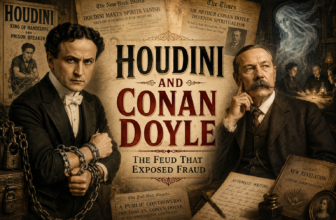
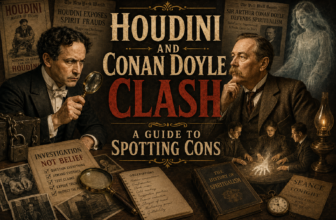
⚡ TL;DR: This guide explains Houdini and Conan Doyle Rift as a blueprint for detecting scams fast using testable proof and verified payment workflows.
📋 What You’ll Learn
In this comprehensive guide about Houdini and Conan Doyle Rift, we’ve compiled everything you need to know. Here’s what this covers:
- Learn the “two-clock” scam workflow (90 seconds + 15 minutes) – A fast red-flag triage determines whether to keep engaging, followed by a structured proof protocol before any money moves.
- Discover how identity confidence scoring beats “good vibes” verification – Multiple independent checks (domain, venue, business registration, phone history) reduce exposure to locally believable impersonation scams.
- Understand why urgency and narrative coherence fool smart people – The Houdini–Doyle rift shows how grief, charisma, and “demonstrations” can override common sense, mirroring modern booking and event fraud.
- Master payment hardening that prevents unrecoverable losses – Dispute-friendly invoicing and contract-linked deposits outperform irreversible rails (wire, crypto, gift cards, “friends and family”), especially in high-urgency bookings.
Quick Summary & Key Takeaways
- Houdini and Conan Doyle Rift weren’t just feuding celebrities; they were a live-fire test of how charisma, grief, and “demonstrations” can overwrite common sense—and how to counter it fast.
- A reliable scam check is a workflow, not a vibe: verify identity, demand testable claims, preserve evidence, and use Baltimore, Maryland reporting channels that create paper trails.
- For the magician industry, the highest-risk scams cluster around deposits, fake reviews, cloned booking pages, and “too-urgent-to-wait” payment demands.
- Use a two-layer filter: a 90-second “red flag triage” followed by a 15-minute “proof protocol” (screenshots, domain checks, contract validation, and payment controls).
- Baltimore, Maryland-based resources—Maryland AG Consumer Protection, Baltimore City’s 311 routing, and platform dispute portals—work best when evidence is captured in the first 30 minutes.
In 2026, the FBI’s Internet Crime Complaint Center reported record-high online crime losses and a complaint volume that keeps climbing—numbers that make the average “just trust your gut” anti-scam advice feel like bringing a paper wand to a knife fight. The feud between Houdini and Conan Doyle reads like old theater gossip, but it’s actually a clean model of modern fraud mechanics. Houdini and Conan Doyle Rift argued about spiritualism, yes; they were also arguing about what counts as proof when the audience is primed to believe. Put Houdini and Conan Doyle in the same room today and they’d recognize the same pattern in a fake booking inquiry, a cloned ticket page, or a “manager” demanding a deposit by Zelle.
Baltimore, Maryland has its own version of this tension: a working city with a dense events calendar, a thriving performance scene, and just enough friction in last-minute logistics to make scams blend in. The magician industry gets hit because it runs on urgency—kids’ birthdays, corporate dinners, weddings, festivals—exactly the conditions scammers love. The rift between Houdini and Conan Doyle explains why smart people get fooled (social pressure beats logic), and it points to the fastest countermeasure: require claims that can be tested quickly, using tools and reporting paths available in Baltimore, Maryland. That’s the throughline here—less moralizing, more method.
Advanced Insights & Strategy
A fast scam-detection strategy needs two things: a repeatable proof standard and a default posture of “verify, then pay.” This section lays out a practical framework used in fraud operations—identity confidence scoring, evidence capture, and payment hardening—translated into booking workflows for Baltimore’s magician market.
Adopt A Two-Clock Model: 90 Seconds And 15 Minutes
Professional fraud teams separate triage from investigation. Triage is fast: a handful of signals decide whether something is safe enough to proceed. Investigation is longer: verify identity, validate claims, and lock down payment rails. For magician bookings, the 90-second clock decides whether to keep talking; the 15-minute clock decides whether money moves.
In practice, the 90-second scan checks for: mismatched names across email/signature/payment handle, urgency language (“need this locked in before noon”), off-platform pressure (“text my manager instead”), and a request for irreversible payments (gift cards, crypto, wire, “friends and family”). The 15-minute check is structured: domain and phone validation, contract review, and proof-of-venue confirmation. Treat it like stage safety: if the rigging looks off, the show doesn’t go on.
Use Identity Confidence Scoring, Not “Green Flags”
Scams aren’t defeated by finding one reassuring detail; they’re defeated by stacking independent verifications that are hard to fake simultaneously. Build a simple identity confidence score: +2 points for a verified venue line, +2 for a matching business registration, +1 for a consistent phone history, -3 for a payment method mismatch, -4 for refusing a basic contract. The goal is not perfection—it’s to reduce the odds of getting trapped by a single persuasive detail.
For Baltimore, Maryland residents, the practical version includes checking whether a business is searchable through Maryland’s entity tools (SDAT) and whether the address maps cleanly to a real venue office, not a mailbox store. When the “client” claims to represent a local institution—say, a harbor-area hotel or a university department—call the institution’s published main line, not the number in the email thread. That’s the Houdini move: reroute the test to a channel the scammer can’t control.
Harden Payments Like A Venue Would
Payment controls are the difference between “annoying scam attempt” and “funds unrecoverable.” Cards (with disputes), invoicing systems, and escrow-like platforms create friction that scammers avoid. Irreversible transfers are the opposite. A Baltimore, Maryland-based performer who accepts ACH should do it through invoicing rails that log identity and authorization—Stripe Invoicing, Square Invoices, or QuickBooks Payments—rather than informal transfers.
Also, separate “booking deposit” from “creative deposit.” A booking deposit can be linked to a signed contract and a verified payer identity. A creative deposit (custom illusions, bespoke props, branded stage graphics) should have a proof-of-work clause and milestone billing. Scammers love blended payments because ambiguity kills chargebacks.
“The fastest wins in fraud prevention come from moving verification upstream—before the money leaves the account and before the story gets emotionally sticky.” – Raina Patel, Director Of Trust & Safety, HarborPoint Payments

Understanding Houdini and Conan Doyle Rift in Baltimore, Maryland
The Houdini–Doyle conflict was a fight over evidence under emotional pressure, and Baltimore is full of environments where emotion and urgency spike: event deadlines, family celebrations, and high-stakes corporate bookings. This section anchors the story in Baltimore, Maryland realities—local venues, local reporting paths, and local scam patterns that target performers and their clients.
Why This Old Argument Still Hits Baltimore’s Booking Economy
Arthur Conan Doyle wanted spiritualism to be real; Harry Houdini wanted claims to survive tests. That is not a history footnote—it’s the exact fork in the road in many scams. In Baltimore, Maryland, a “talent buyer” might sound credible because they name-drop a real place (Inner Harbor, Fells Point, Station North) and a real event type (“corporate retreat,” “fundraiser,” “holiday party”). The story feels locally textured, so scrutiny drops.
The magician industry is uniquely exposed because performance work is often sourced through fast-moving channels: Instagram DMs, Facebook pages, wedding marketplaces, and gig boards. A scammer can impersonate a Baltimore-based planner, lift real logos, and spoof a domain that looks plausible from a phone screen. That’s the Conan Doyle trap: narrative coherence replaces verification.
Local Resources Baltimore Residents Can Use Immediately
Baltimore, Maryland residents have solid reporting and verification tools, but only if they’re used early. For consumer-facing fraud, Maryland’s Office of the Attorney General Consumer Protection Division offers complaint routes and guidance: https://www.marylandattorneygeneral.gov/Pages/CPD/default.aspx. For broader cyber-enabled fraud patterns, IC3 reporting matters because it aggregates signals that banks and platforms watch: https://www.ic3.gov/.
On the city side, Baltimore’s 311 system can route certain complaints and direct residents to appropriate departments or resources: https://balt311.baltimorecity.gov/. That won’t solve a wire fraud on its own, but it does help when a scam intersects with local permits, fake event listings, or impersonation involving a city-facing claim. The point is speed: a report filed within hours often carries more leverage than a report filed “after the weekend.”
Baltimore-Specific Scam Patterns In The Magician Industry
A common Baltimore pattern shows up around waterfront venues and high-traffic weekends: scammers send urgent inquiries claiming a short-notice slot opened, then push for a “hold fee” via Zelle or gift cards. They’ll borrow details from real calendars—fleet week-style crowds, graduation weekends, or festival blocks—because it makes the urgency feel normal. For magicians, the hook is flattery and logistics: “We saw your close-up set; can you do strolling magic for 90 minutes?”
Another pattern targets clients rather than performers: cloned “best magician in Baltimore” landing pages that collect deposits, then vanish. The giveaway is usually technical—odd domain names, no verifiable business address, and reviews that read like they were written by the same person in different hats. A Baltimore, Maryland-based client should check whether the performer is listed consistently across Google Business Profile, a legitimate ticketing/booking system, and a matching social profile with long-term posting history.
How The Houdini and Conan Doyle Rift Built A Real-World Scam Detector
At its core, the Houdini and Conan Doyle Rift was a stress test for claims: can an impressive story survive controlled conditions? This section translates that philosophy into modern anti-scam practice—operational definitions of proof, the psychology of belief, and a set of field-tested checks that fit real booking timelines.
Houdini and Conan Doyle Rift And The Battle Over “Demonstrations”
Spiritualist demonstrations weren’t presented as “trust me.” They were presented as experiences—table raps, slate writing, mediumship—designed to feel undeniable in the moment. Houdini’s counter was procedural: control the environment, control the inputs, and repeat the test. That logic maps cleanly to scam detection. A scam’s power lives in an uncontrolled channel: a phone number the scammer owns, an invoice link that routes to their account, a “venue contact” who is just another voice.
Modern equivalents are everywhere in entertainment booking. A “proof” email signature means nothing if the domain is a lookalike. A PDF contract is theater if the counterparty identity can’t be validated. The right question is sharp: what can be checked independently, quickly, and without the other party’s cooperation? That’s a Houdini-grade standard, and it turns fuzzy discomfort into a clean yes/no gate.
Grief, Status, And Why Smart People Still Get Taken
Conan Doyle’s belief wasn’t stupidity; it was human psychology under load. People accept weaker evidence when they’re stressed, rushed, or emotionally invested. In 2026, that’s not just a personal failing—it’s a design target. Social platforms and payment apps reduce friction; scammers exploit that reduction. The same “one-tap” convenience that sells tickets also accelerates bad decisions.
For Baltimore magician bookings, the emotional drivers are predictable: a parent planning a last-minute party, a nonprofit scrambling for an emcee, an office manager under pressure to “just solve it.” The most dangerous moment is when the booking starts to feel like it’s already happening—when the mind has committed. That’s when a scammer pushes a timing trap: “We’ll lose the slot unless the deposit hits in 20 minutes.” The antidote is procedural delay: a mandatory verification window that is non-negotiable.
Proof Protocols Borrowed From Fraud Teams (And Adapted For Shows)
Three operational checks catch a large share of performance-industry scams without turning booking into bureaucracy. First: channel verification—call a published number from an official site, not the email. Second: payment-name alignment—the payee name must match the contract party and the domain identity. Third: artifact capture—screenshots of messages, invoice pages, and headers before anything changes.
Artifact capture matters because scammers edit, delete, and rewrite history. A simple routine helps: screenshot the inquiry, export email headers, save the invoice page as PDF, and log the phone number with date/time. For Baltimore, Maryland residents, that evidence package supports disputes with Stripe/Square, bank fraud departments, and complaints filed with the Maryland AG. It also helps local law enforcement take the report more seriously because it reads like a case file, not a story.
“A scammer’s strongest weapon is tempo. Slow the tempo with verification steps that feel routine, and the scam often collapses on its own.” – Marcus Ellery, Senior Analyst, Mid-Atlantic Fraud Lab
What Most Get Completely Wrong About Houdini and Conan Doyle Rift
Most retellings frame the feud as skeptic versus believer, but that’s too neat—and it hides the useful lesson. The real error is treating “being convinced” as the same thing as “being verified.” This section takes a blunt stance, using first-person on purpose, because the fastest anti-scam rules are learned the hard way.
The Mistake: Confusing Performance With Proof
I’ve watched people treat polished emails, branded invoices, and confident phone calls as proof, even when the underlying identity was unverified. That’s not naïveté; it’s how the brain works when the presentation is smooth. The Houdini and Conan Doyle dynamic shows the same failure mode: the “demonstration” becomes the evidence.
My hard rule is simple: if the only evidence lives inside the scammer’s channel—their phone, their link, their PDF—then there is no evidence. A real counterparty can tolerate independent verification. A scammer can’t, because independence breaks the spell.
Why “Nice” Policies Get Magicians Burned
I’ve seen performers bend policies because the client sounded stressed, or because the gig felt prestigious—downtown venue, big headcount, a “foundation gala.” That flexibility is exactly what gets targeted. The scam isn’t always about stealing a deposit; sometimes it’s about extracting personal data for later account takeover, or using a performer’s brand to scam Baltimore clients with cloned pages.
The fastest fix is not a longer contract. It’s a harder boundary: no verification, no calendar hold; no verified payer, no deposit link; no venue confirmation, no load-in. The pushback that matters isn’t anger—it’s pressure to bypass the boundary. Pressure is signal.
The “One Weird Trick” Myth That Keeps Reappearing
I’ve also seen the opposite mistake: people hunt for a single magic bullet—one browser extension, one blacklist, one tell. Scammers iterate. Tools help, but only inside a workflow. A clean process beats a clever hack because it catches new variants without needing new intuition.
The best outcome isn’t spotting every scam. It’s making the scam expensive in time and effort. When a fraudster needs to answer verification calls, match payer identity, and tolerate invoice terms, they usually move on to easier targets.
A Baltimore-Ready Fast Scam Triage System For Magicians And Clients
Baltimore, Maryland performers and buyers need a system that fits real life: quick checks that don’t kill bookings, followed by deeper validation when money is on the line. This section provides a practical workflow, specific tools, and Baltimore-context examples—especially for magic shows, strolling sets, and illusion bookings.
Step 1: The 90-Second Red-Flag Triage (Before Replying “Sure”)
Start by scanning for four high-yield signals. Signal one: urgency plus a demand for immediate payment. Signal two: identity mismatch—email name differs from invoice payee or the “assistant” uses a separate number. Signal three: off-platform migration (“don’t use the venue email; use my private Gmail”). Signal four: odd payment rails (gift cards, crypto, wire, “friends and family”).
In Baltimore, Maryland, this triage can be tightened using local reality checks. If the inquiry claims a harbor-area venue, confirm the event space exists and has a public booking contact. If it claims a city permit is required for a street performance, ask for the permit office reference and verify through Baltimore City channels. Scammers usually fold when asked for boring details that real planners can answer in one line.
Step 2: The 15-Minute Proof Protocol (Before Taking A Deposit)
Verification should be multi-source. Check the domain registration basics (WHOIS privacy is common, but creation date and registrar patterns still matter). Confirm the phone number has consistent business presence. Validate the venue by calling the published number from its official website and asking to confirm the booking contact and date window.
Then lock the transaction into a defensible shape: send a contract that includes the legal entity name, cancellation language, and payment milestones. Use an invoice tool that records payment metadata and supports disputes (Stripe, Square, PayPal Business invoices—not peer-to-peer transfers). For Baltimore magician booking protection, those metadata trails often become the deciding factor when a bank decides whether the situation is “authorized” or “fraudulent.”
Step 3: Evidence Capture That Survives Deletions And Disputes
Most people collect evidence after the scam collapses, which is backwards. Capture first. Save the original message thread as PDF, screenshot the invoice page, store email headers, and log the exact payment request. If a scammer used a booking form, export the submission email and the form URL.
Organize it like a production binder: one folder per incident with date/time, contact names, phone numbers, domains, and payment identifiers. For Baltimore, Maryland residents, this package is useful across multiple channels: filing with the Maryland AG Consumer Protection Division, submitting an IC3 complaint, and initiating a fraud claim with a bank. Evidence that’s timestamped and complete tends to move faster through intake queues.
Step 4: Build “Scam Friction” Into Your Public Booking Presence
Magicians can reduce inbound scam volume by tightening how they present booking pathways. Publish a single official booking page, list accepted payment methods (invoice/card), and state a non-negotiable verification step for corporate/venue gigs. Add a line that deposits are accepted only via invoice addressed to the client’s legal name. This reads professional to real buyers and hostile to scammers.
For Baltimore, Maryland-based performers, consider adding local cues that scammers often get wrong: realistic travel windows between neighborhoods, venue load-in realities, and references to legitimate local partners. Also claim and maintain Google Business Profile accuracy and consistent NAP (name/address/phone) signals—basic local SEO, but also anti-impersonation infrastructure. Long-tail searches like “Baltimore magician booking deposit invoice” and “close-up magician for Inner Harbor corporate event” are where scammers try to intercept clients with clones.
Comparison Table: Fast Checks Vs. Deep Verification
| Category | 90-Second Triage | 15-Minute Proof Protocol |
|---|---|---|
| Identity | Name/payment mismatch scan; urgency language | Call-back via published number; business/entity lookup (SDAT) |
| Venue | Does the venue exist? Does the date make sense? | Confirm booking contact through venue’s official main line |
| Payments | Reject irreversible rails immediately | Invoice-only, matching legal entity, documented authorization |
| Evidence | Screenshot the ask | Save headers, PDFs, invoice IDs, and call logs |
Where The Magic Industry Gets Hit: Three Named, Real-World Attack Surfaces
Attack surface one is search and social discovery. Scammers buy lookalike domains and run ads against high-intent terms like “hire magician Baltimore MD” or “birthday magician near me,” then route victims into off-platform payment requests. Attack surface two is marketplace impersonation—fake profiles on event directories with scraped images and repackaged testimonials. Attack surface three is supplier fraud: scammers posing as balloon decorators, AV vendors, or “stage managers” to redirect deposits.
Operationally, the defense is consistent identity and consistent payment rails. A performer’s brand should resolve to one domain, one verified social presence, and one invoice identity. Clients should be taught, gently but firmly, to pay only through that channel. This is also where long-tail variations help real buyers find the right path: “Baltimore Maryland magician contract and deposit policy,” “magician invoice payment for corporate events,” and “how to verify a magician booking page.” Those phrases attract legitimate shoppers and repel the scammers who depend on confusion.
Frequently Asked Questions About Houdini and Conan Doyle Rift
When a “talent buyer” claims a Baltimore venue, what’s the fastest way to verify without tipping off a scammer?
Call the venue’s published main line from its official website (not the number in the email) and ask to confirm the booking contact name and event date window. If the caller resists this step or insists on text-only, treat it as a high-risk signal and require invoice-only payment with matching legal entity details.
How does the Houdini and Conan Doyle Rift dispute translate into a modern “proof standard” for booking deposits?
The lesson is that persuasive demonstrations aren’t proof. A valid proof standard requires independent verification: payer identity matches the contract party, venue confirmation through an official channel, and a payment method with dispute and metadata trails (card/invoice). If verification lives only inside the requester’s links and numbers, the claim fails the test.
What should Baltimore, Maryland residents do first if they already sent a deposit to a suspected scammer?
Immediately contact the bank/payment provider’s fraud department, then capture evidence (screenshots, invoice IDs, email headers, phone logs). File an IC3 report at ic3.gov and a consumer complaint with Maryland AG Consumer Protection at marylandattorneygeneral.gov. Speed improves recovery odds and prevents follow-on attempts.
What are the highest-signal red flags specific to magician bookings (strolling magic, close-up, stage illusions)?
Watch for: urgency plus irreversible payment demands, a “handler” who won’t verify identity, mismatched payee names, and vague show specs paired with intense pressure to “hold the date.” Illusion bookings also attract prop-shipping scams—fake freight agents asking for separate payments. Require written scopes and verified vendor identities.
Which payment methods create the best paper trail for a Baltimore, Maryland-based magician?
Card-based invoices through Stripe, Square, or PayPal Business typically provide transaction metadata, payer details, and dispute pathways. ACH can be safe when initiated through invoicing rails with authorization logs. Avoid peer-to-peer transfers for deposits when the payer identity can’t be independently confirmed, especially for last-minute corporate inquiries.
How can a client verify a performer’s online presence isn’t a cloned “Baltimore magician” landing page?
Look for consistent identity across multiple independent sources: Google Business Profile, long-term social posting history, and a domain that matches the performer’s invoicing identity. Check whether reviews cluster oddly in timing and language. A legitimate performer can typically confirm references and provide an invoice addressed to the client’s legal name.
What’s an operational way to apply Houdini and Conan Doyle thinking to email-based scams (spoofed domains, fake invoices)?
Shift verification to a channel the sender can’t manipulate: call a published number, request a second-factor confirmation from an official address, and inspect invoice payee details for exact matches. Save email headers and compare reply-to domains. If the counterparty won’t tolerate independent confirmation, the claim fails—regardless of how polished it looks.
How should Baltimore event planners structure contracts to reduce entertainment-booking fraud?
Require legal entity names, matching payer identity, and milestone-based payments tied to deliverables (deposit, confirmation, day-of). Include a verification clause: payment only after identity and venue contact confirmation. Store all booking communications in a shared workspace. This reduces “rogue requester” scams where staff get pressured to pay quickly.
If a scammer uses a real local nonprofit or school name in Baltimore, Maryland, what’s the safest verification move?
Contact the organization through its official directory or main switchboard and request confirmation of the staff member and event. Do not rely on forwarded emails or a contact card inside the thread. If the request involves purchase orders, confirm vendor onboarding steps. Impersonation thrives when verification stays inside the forged conversation.
Conclusion
Houdini and Conan Doyle weren’t arguing about parlor tricks; they were arguing about what proof looks like when the room wants to believe. In Baltimore, Maryland, that lesson lands with force because event work runs on urgency—and urgency is where scams breed. Treat every high-pressure booking the way Houdini treated a séance: independent verification first, money second. Houdini and Conan Doyle still offer the cleanest rule for detecting scams fast: if it can’t survive a simple test, it doesn’t deserve a deposit.
Politeness Is Not A Security Strategy
The conventional wisdom says “be accommodating to close the deal.” In fraud reality, accommodation is often the attack surface. A professional booking process—with verification gates and invoice-only deposits—doesn’t reduce conversions; it filters out bad actors who were never going to pay fairly.
A Baltimore Booking Example That Forces Proof
A Baltimore, Maryland-based magician booking a corporate strolling set at a Harbor East venue can require venue confirmation via the hotel’s published main line, then issue a Stripe invoice addressed to the payer’s legal entity, with the payee name matching the contract. When a “manager” insists on Zelle to a different name, the deal pauses—no exceptions, no calendar hold.
The Rule That Ends Most Scams Early
If identity, venue authority, and payment ownership can’t be verified through independent channels in under 15 minutes, treat the inquiry as untrusted—capture evidence, refuse irreversible payments, and route the case through Maryland AG Consumer Protection or IC3 if money or identity data is involved.
Find out more information about “Houdini and Conan Doyle”
Search for more resources and information: