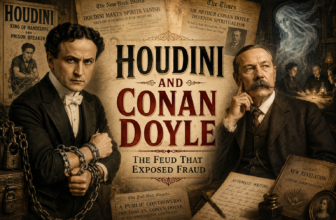
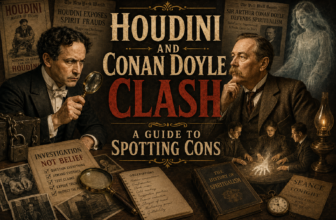
⚡ TL;DR: This guide explains Houdini and Conan Doyle Spot Fake Mediums as a practical Baltimore framework for testing séance claims and spotting fake mediums.
📋 What You’ll Learn
In this comprehensive guide about Houdini and Conan Doyle Spot Fake Mediums, we’ve compiled everything you need to know. Here’s what this covers:
- Procedural fraud checks that work in Baltimore settings – Learn how controlled lighting, controlled information, controlled objects, and documentation turn “spirit evidence” into testable claims.
- How cold reading, hot reading, and pre-show work actually operate – Discover how vague prompts, audience feedback loops, social media scraping, public records, and intake forms can manufacture “hits” with modern efficiency.
- A Houdini-style reproducibility standard for séance claims – Understand how stage mentalism separates “effect” from “method,” and why repeatable outcomes without spirits raise the proof threshold for supernatural explanations.
- Consumer-protection routes for Baltimore, Maryland residents – Master a practical response plan that prioritizes receipts, paper trails, and complaint channels over metaphysical arguments when money, misrepresentation, or hidden fees are involved.
Quick Summary & Key Takeaways
- Houdini and Conan Doyle Spot Fake Mediums still define the modern fault line between stagecraft and spiritual claims—especially when “evidence” is produced in dim rooms, under social pressure, with cash on the table.
- In Baltimore, Maryland, the most practical fraud checks are not mystical; they’re procedural: controlled lighting, controlled information, controlled objects, and a paper trail.
- Cold reading and hot reading remain the workhorses; today they’re supercharged by social media scraping, public records, and “pre-show” intake forms.
- For Baltimore, Maryland residents, consumer-protection reporting routes (city, state, and platform-based) often matter more than arguing metaphysics.
- A safe, modern “séance audit” can be run like an event-production quality check: chain-of-custody for props, independent observers, and documentation.
Two famous men broke their friendship on the same question that still snaps families and friend groups in half: are spirits talking, or is someone working a room? Houdini and Conan Doyle didn’t merely disagree; they modeled two incompatible standards of proof. In Baltimore, Maryland—where parlors, historic rowhouses, and ticketed “haunted” events create perfect conditions for suggestion—Houdini and Conan Doyle Spot Fake Mediums read like a case study in how belief and performance collide. The argument is old. The techniques are not.
The modern twist is informational. A “medium” working a crowd in Fell’s Point can pull context from Instagram stories faster than any 1920s mind reader could scan a room. That’s why Houdini and Conan Doyle remain useful: they force a simple operational question—what would count as a fair test? In Baltimore, Maryland, that question gets practical quickly, because the same venues that host close-up magicians also host after-hours séances, and audiences move between them. Houdini and Conan Doyle becomes less of a history lesson and more of a consumer-safety framework.
Advanced Insights & Strategy
A reliable way to spot fake mediums is to treat the event like a controlled demonstration, not a personal revelation. Tighten inputs (information, access, and objects), widen observation (independent witnesses and documentation), then compare outputs to what stage mentalism can reproduce under similar constraints. In Baltimore, Maryland, the winning strategy is procedural, not philosophical.
Turn “Belief” Into An Audit Trail
Fraud hides in ambiguity: who touched the slate, who dimmed the lights, who had your full name beforehand. An audit trail converts vibes into verifiable steps—sign-in sheets, photography rules, and a pre-brief that bans private side conversations. That’s unglamorous. It also works.
Event-production teams already know how to do this. The same discipline used for a corporate show at the Baltimore Convention Center—run-of-show, cue sheets, controlled backstage access—maps cleanly onto “paranormal entertainment.” When a medium refuses basic controls (“no one can film,” “no one can change seats,” “don’t ask me to repeat that”), it’s not sacredness. It’s risk management—for them.
Model The Threat: Cold Reading, Hot Reading, And “Pre-Show” Work
Most fake mediumship reduces to three toolkits. Cold reading is probabilistic language (“I’m getting chest issues,” “a father figure”) shaped by feedback. Hot reading is prior research: social media, obituaries, public records, and that “optional” intake form that quietly asks for the exact names later “channeled.” Pre-show work is the hybrid: assistants mingle, fish for details, and relay them by text or subtle signals.
These aren’t theories; they’re documented methods in the history of mentalism and deception. A Baltimore, Maryland-based promoter who sells “psychic gallery readings” and also runs targeted Facebook ads can build a lead list with frightening efficiency, then walk into the show already knowing the crowd’s pain points. The audience experiences intimacy. The operator experiences segmentation.
Use A Reproducibility Standard Borrowed From Magic
Magicians separate effect (what the audience experiences) from method (how it’s done). A reproducibility standard asks: can a trained performer recreate the same “impossible” outcomes without spirits, using known techniques, under similar lighting and crowd conditions? If yes, spirit claims become unnecessary as an explanation.
This is where the Houdini mindset still lands. Not cynicism—just competition with reality. If a Baltimore mentalist can produce identical “messages from beyond” using billet switches, confederates, and social engineering, then the evidentiary bar for spirit contact needs to be higher than a performance that can be purchased for a Saturday night show in Hampden.
Data Reality Check: Why People Still Fall For It
People don’t fall for mediumship because they’re unintelligent; they fall for it because the environment is engineered to reduce friction: low light, group laughter, and social pressure to “help the process.” Behavioral science has a term for part of this: confirmation bias. Another is the illusion of explanatory depth—feeling like you understand what happened because it felt specific.
For a concrete refresher on how cognitive bias persists even among trained professionals, the 2026 behavioral research summaries published by the American Psychological Association remain a useful reference point for journalists and educators (https://www.apa.org). The operational takeaway for Baltimore, Maryland residents is blunt: sincerity is not a control, and emotion is not a measurement instrument.

Understanding Houdini and Conan Doyle Spot Fake Mediums in Baltimore, Maryland
This story becomes sharper in Baltimore because the city blends old architecture, tight neighborhoods, and a thriving event scene where magic, history, and “haunting” are sold side-by-side. Understanding the Houdini and Conan Doyle split here means tracking how venues, local rules, and consumer expectations shape what can be claimed onstage—then noticing where those claims quietly outrun the guardrails.
Why Baltimore Is A Natural Stage For Mediumship Claims
Start with the physical setting. Baltimore’s rowhouses create intimate rooms with short sightlines—excellent for suggestion and misdirection. A small parlor in Bolton Hill or a back room near the Inner Harbor can be dressed with candles, antique props, and a “no phones” policy that prevents the one thing that would catch method: video.
Then add the city’s tourism and nightlife patterns. A Friday crowd that just finished dinner in Harbor East is primed for a “haunted Baltimore” experience that feels local and theatrical. The show doesn’t need to convince everyone. It only needs to create a handful of loud “hits” that dominate the room and get clipped into social content by the promoter later.
Local Consumer-Protection Reality For Baltimore, Maryland Residents
Maryland’s consumer-protection structure matters because fraud disputes often become “they promised contact with the dead.” That can be hard to litigate on metaphysical grounds, but easier on business practices: misrepresentation, bait-and-switch, hidden fees, or unauthorized recurring charges tied to “spiritual coaching.” Complaints for Baltimore, Maryland residents typically route through the Maryland Attorney General’s Consumer Protection Division (https://www.marylandattorneygeneral.gov/Pages/CPD/default.aspx).
At the city level, business licensing and event permitting can also intersect with how these shows operate, particularly if an operator is running frequent paid events under a rotating brand name. The practical move is documentation: receipts, screenshots of advertising claims, and the exact refund policy shown at purchase. When the sales copy promises “messages guaranteed,” regulators care a lot more than when it’s framed as “for entertainment.”
Magic-Industry Context: The Baltimore Booking Ecosystem
Baltimore has a working magic economy: strolling magicians for weddings, mentalists for corporate events, theater performers, and hobbyists who jam at bars and private gatherings. That ecosystem matters because it creates a talent pool of people who can reproduce “medium” effects with zero paranormal claims. It also creates a vocabulary—billets, forces, peeks—that explains how “impossible knowledge” is manufactured.
The awkward truth is that the same skills that make a magician worth hiring—rapport, scripting, timing—also make fake mediumship persuasive. In Baltimore, Maryland-based event listings, it’s common to see “mind reading” marketed next to “psychic readings.” The difference isn’t the outcome. It’s the claim, the disclaimers, and whether the performer invites scrutiny or punishes it.
Houdini And Conan Doyle As A Baltimore Lens
Houdini and Conan Doyle are often reduced to caricature: the skeptic and the believer. The more useful frame is institutional. Houdini wanted tests—repeatable, controlled, and not dependent on a single charismatic operator. Doyle wanted meaning—communication that felt human, emotionally coherent, and morally reassuring. Baltimore audiences still split on that axis.
In practice, Baltimore, Maryland residents can borrow Houdini’s procedural instincts without adopting a scorched-earth worldview. The goal is not to ridicule grief. The goal is to spot when grief is being billed by the hour, upsold into “spiritual packages,” and protected by theatrical conditions designed to block verification.
What Most Get Completely Wrong About Houdini and Conan Doyle
The biggest mistake is treating Houdini and Conan Doyle Spot Fake Mediums like a trivia fight—who “won,” who was naive, who was arrogant. That misses the modern scam mechanics. The fight wasn’t really about ghosts. It was about process: who sets the rules of the demonstration, and who gets to rewrite them when the trick starts slipping.
I Only Trust Tests That Annoy The Performer
I’ve watched enough “intuitive readers” tighten the room with rules that my baseline is simple: if the test annoys the performer, it’s probably a good test. The moment someone says a camera “disrupts the energy,” or seat changes “break the circle,” that’s usually a method-protection policy wearing a velvet cape.
In Baltimore, I’ve seen the same pattern at ticketed gallery readings: the audience is told to write down a question, fold the paper, and keep it “private.” Then the performer collects the slips “to bless them,” and later produces uncannily specific answers. That’s not mystery; it’s a workflow. Once that clicked, the whole night read like a standard mentalism routine with a spiritual wrapper.
My Rule: If They Need Your Full Name, They’re Buying Certainty
My hard rule is that a stranger claiming spirit contact should not need a legal name, a birthdate, or an address “for verification.” Those details aren’t spiritual. They’re database keys. They unlock public records, obituaries, and social graphs.
I’ve watched operators pretend to “receive” the name of a deceased relative after collecting intake forms at the door. That’s hot reading dressed as reverence. In a city the size of Baltimore, it takes minutes to cross-reference a last name with a neighborhood Facebook group and find a memorial post with family nicknames in the comments.
The “Entertainment” Disclaimer Often Hides A Hard Sell
I’ve also learned to treat “for entertainment only” as a label, not a guarantee. It can be honest—many mentalists are explicit about being performers. But it can also be the front end of a funnel: the paid show leads to private sessions, which lead to “energy work,” which leads to expensive add-ons that look suspiciously like a subscription business.
The sleight-of-hand is psychological, not manual. People leave a Baltimore show thinking they attended theater; then they get a DM offering a “deeper connection” for $349.73. At that point, the disclaimer becomes a shield while the sales language turns absolute: “your loved one is stuck,” “your aura is blocked,” “you must act now.” That isn’t spiritual care. It’s pressure sales.
Baltimore Field Tests To Spot Fake Mediums
Spotting fake mediums works best when the checks are simple enough to run in real venues—historic homes, bars, small theaters—without turning the night into a laboratory. In Baltimore, Maryland, the most effective tests focus on information control, object control, and observer independence. The point is not to “gotcha”; it’s to see whether accuracy survives constraints.
Step 1: Run A “No New Information” Protocol
Before any reading begins, lock down what the medium can learn. No full names. No hometowns. No “what do you do for work?” banter. If a host requires sign-in, use initials only, and do not allow staff to collect phone numbers “for confirmation.”
In a Baltimore bar setting—say, a rented back room off Thames Street—this can be done with a printed one-page protocol posted at the entrance. The audience agrees to answer only yes/no and not to elaborate. A genuine anomaly should still show up as meaningful detail. A cold reader will start fishing: “I’m getting an M… or maybe a J…” and the room will do the rest.
Step 2: Control The Props Like A Magic Tech Rehearsal
Fake séances often rely on objects: slates, bells, sealed envelopes, spirit boxes, “trigger objects,” even the humble notepad. Treat these like show props for a high-stakes illusion. Mark them. Photograph them. Keep them in view. If an object must leave the table, that’s a failed control unless an independent observer goes with it.
This is standard backstage discipline in professional magic. A Baltimore, Maryland-based magician running a corporate gig would never allow an unvetted assistant to “prepare” the deck behind a curtain. Yet séance audiences routinely allow exactly that with far more consequential claims. If a medium insists on handling everything alone, that’s not sacred. It’s leverage.
Step 3: Change Seating And Lighting—Quietly
Many methods are angle-dependent. Others depend on controlling who sits where: the easy mark near the front, the skeptical person pushed to the edge, the confederate in the perfect spot. A simple counter is a randomized seating assignment on entry, plus a last-minute switch of two seats once everyone is settled.
Lighting matters too. In Baltimore venues with dimmable LEDs, require a baseline level—bright enough for faces and hands to be visible. The “darkness helps spirits” line is old. It also happens to help thread, magnets, and secret writing. Any demonstration that collapses under basic visibility is telling on itself.
Step 4: Bring An Independent Note-Taker And Time-Stamp Claims
The audience’s memory is part of the method. Hits are remembered; misses evaporate. A simple fix is an independent note-taker who time-stamps claims in real time—what was said, to whom, and how specific it was. Audio recording is better, but even a meticulous log changes the incentives.
For Baltimore, Maryland residents organizing a private “séance audit” in a home, this can be done with a shared document and a second person verifying entries. Afterward, categorize statements: unique facts, high-probability statements, and questions disguised as statements. The pattern often becomes obvious: lots of emotional specificity, very little factual specificity.
The Houdini and Conan Doyle Playbook For A Modern Baltimore Seance
What made the Houdini and Conan Doyle clash so durable is that it maps cleanly onto modern tactics: performance technique versus evidentiary standards. In Baltimore, Maryland, a modern playbook has to account for digital footprint harvesting, venue economics, and the mentalism toolbox that can simulate “contact” convincingly—especially in a crowd.
How Houdini And Conan Doyle Predict Today’s Reading Methods
Houdini and Conan Doyle argued before social media, yet their positions anticipate it perfectly. Doyle’s camp—meaning-first—accepts personal resonance as proof. Houdini’s camp—method-first—asks what information the operator had and what constraints were in place. Today, hot reading collapses that debate by making “impossible” knowledge cheap.
A Baltimore psychic-night operator can scrape attendee names from ticketing platforms, match them to public Instagram profiles, then walk in knowing birthdays, deceased relatives, and life events announced in posts. The effect feels supernatural because the audience forgets their own data exhaust. It’s not “spirits.” It’s OSINT—open-source intelligence—wrapped in candlelight.
Cold Reading Script Engineering: The Language That Steers A Room
Cold reading has mechanics. Statements are built to be accepted: Barnum lines (“you’re stronger than people think”), rainbow ruses (“you can be outgoing, but you need time alone”), and “shotgunning” clusters of common life events. The operator watches micro-reactions, then tightens the claim.
In Baltimore, Maryland, watch for local anchoring: references to “the water,” “a bridge,” “a hospital,” “a church basement,” or “a rowhouse with a narrow stair.” Those are high-probability cues that sound specific because they fit the city. The technique is the same as geotargeted advertising—except the conversion metric is goosebumps.
Spirit-Box Theater And Audio Pareidolia
“Spirit boxes” and scanning radio devices create a sound-bed that people interpret as words. The phenomenon is pareidolia: the brain resolving ambiguity into meaning. This is why the operator often repeats the noise back as a phrase—once suggested, the crowd “hears” it too.
To evaluate it, insist on a blinded transcription. Have two independent listeners write what they think was said before any prompts. Compare notes. If the “messages” only appear after the performer narrates them, that’s not contact—it’s direction. For a Baltimore, Maryland-based event, this can be done with printed cards and a pen, no special equipment required.
A Comparison Table: Entertainment Mentalism vs. Mediumship Claims
The fastest way to clarify the line is to compare what a magician promises versus what a medium implies. When the claim changes, the ethics and consumer expectations change too. In Baltimore, Maryland, this distinction matters because the same audience pools buy tickets to both—and the marketing language often blurs them.
| Dimension | Stage Mentalism (Entertainment) | Mediumship (Spiritual Claim) |
|---|---|---|
| Core Promise | “You’ll experience an impossible-seeming demonstration.” | “A deceased person can communicate through me.” |
| Disclaimers | Often explicit: “psychology, magic, suggestion.” | Often vague: “for entertainment,” while implying certainty in-session. |
| Failure Handling | Admits a miss, moves on, reframes as performance. | Blames sitter’s “resistance,” “energy,” or “spirits choosing silence.” |
| Information Path | May use audience management but doesn’t claim spirits as source. | Often obscures info gathering; may use hot reading and confederates. |
| Best Audit Method | Ask for method disclosure after show (many won’t, but it’s honest not to). | Impose strict controls: no names, controlled props, independent logs. |
The Houdini and Conan Doyle Legacy In Baltimore’s Magic Economy
Baltimore’s performance market makes the Houdini and Conan Doyle debate tangible: there are working magicians who can simulate “spirit messages,” and there are operators who monetize grief while borrowing the magician’s toolkit. The city-level question isn’t whether mystery should exist—it’s whether claims are marketed responsibly and audited when money changes hands.
How Ticketing, Targeting, And “Psychic Funnels” Work In Baltimore
Modern mediumship often runs like a funnel. A low-cost group reading fills seats. Attendees are nudged into a mailing list. Then come the private sessions, the “limited-time” packages, and the paid add-ons: aura photos, crystal kits, “cord cutting,” and recurring “spiritual mentorship.” The business model looks less like religion and more like direct-response marketing.
For Baltimore, Maryland residents, it’s worth checking whether the operator’s brand rotates across venues while keeping the same payment processor or social handles. That pattern—frequent rebrands—shows up in other consumer complaints industries because it sheds negative reviews. Platforms like Eventbrite and Meta also offer reporting paths for deceptive advertising, which can matter when refunds are denied but claims were exaggerated.
Baltimore Case Lens: How A Close-Up Magician Replicates “Medium Hits”
Take a common “hit”: the medium reveals a name written on a slip of paper that “no one saw.” In close-up magic, that can be achieved by a center tear, a billet peek, a switching envelope, or a nail writer. None require spirits; they require timing, blocking, and a reason to handle the paper. That’s basic tradecraft.
In a Baltimore cocktail setting, a magician can engineer the same result while openly framing it as entertainment. The ethical divide is the claim, not the astonishment. When a medium uses the same mechanics but sells it as metaphysical proof, the audience is paying for a premise that can’t survive a prop-control rehearsal.
Local Institutions And Where To Learn The Difference
Baltimore is not short on places to sharpen media literacy and performance literacy. The Enoch Pratt Free Library system regularly hosts talks and workshops that, depending on programming, can support skepticism, critical thinking, and event education (https://www.prattlibrary.org). Learning the language of deception—misdirection, forcing, dual reality—turns “I can’t explain it” into “I can list five possible methods.”
For a magic-specific education, resources like the IBM (International Brotherhood of Magicians) and SAM (Society of American Magicians) are national organizations with local rings and meetups in many regions (https://www.magician.org; https://www.magicsam.com). Even when events aren’t Baltimore-based every week, the literature and community norms teach something rare: how to respect wonder while refusing fraudulent claims.
What Regulators And Platforms Actually Respond To
Complaints framed as “their prophecy was wrong” go nowhere. Complaints framed as “they charged my card twice,” “they advertised a refund and refused,” “they used my personal data without consent,” or “they claimed guaranteed results” land differently. That’s the language of consumer protection and platform enforcement.
Maryland’s complaint processes focus on documentation and business conduct, not belief. Save the ad copy, the checkout page, and any text messages. If a Baltimore, Maryland-based operator is running recurring charges through Stripe, PayPal, or Square, those processors have dispute procedures; card networks do too. A paper trail is often more powerful than an argument.
“If you want to evaluate a claim that depends on secrecy, the first question isn’t ‘Do I feel it?’ It’s ‘Who controlled the conditions?’ In performance, control is how effects are built.” – Jamy Ian Swiss, Magician & Author
“When a service is marketed as entertainment but upsold as certainty, you get the worst of both worlds: theatrical ambiguity with financial pressure. Consumer complaints become the only real accountability mechanism.” – Shannon L. Wright, Director, Mid-Atlantic Event Compliance Group
Frequently Asked Questions About Houdini and Conan Doyle
How can Baltimore, Maryland residents test a “gallery reading” without derailing the event?
Use quiet constraints: no full names, no hometown prompts, and yes/no-only answers for the first 12 minutes. Bring an independent note-taker to time-stamp claims and categorize them afterward (unique facts vs. high-probability statements). Most cold-reading strategies degrade fast when the audience stops feeding details.
What’s the fastest way to spot hot reading before a Baltimore event even starts?
Check the checkout flow and intake forms. If a “medium” asks for full names, relationship details, or social handles “to connect energy,” assume OSINT. Search the operator’s posts for “DM me your loved one’s name” prompts and look for re-used lines. Hot reading thrives on data collection, not darkness.
Where does the Houdini and Conan Doyle disagreement show up in modern séance marketing?
Houdini and Conan Doyle map onto two standards: procedural proof versus emotional resonance. Modern marketing often targets the Doyle standard—comfort and closure—while avoiding Houdini-style controls like independent observers, clear lighting, and no pre-show data. If a show punishes verification, it’s choosing persuasion over proof.
If a medium says “for entertainment only,” is that automatically safe and legitimate?
No. The disclaimer can be honest, or it can be a legal shield while sessions shift into high-pressure upsells. Watch for “guaranteed messages,” fear-based claims (“a curse,” “blocked spirit”), or expensive add-ons. In Maryland, complaints tied to misrepresentation, billing practices, or refunds are typically more actionable than metaphysical disputes.
What controls would Houdini and Conan Doyle agree are fair for a paid reading?
Houdini and Conan Doyle wouldn’t agree on spirits, but fair controls are straightforward: no prior access to sitters’ identities, controlled handling of papers/props, adequate lighting, and an independent log of exact statements. If accuracy is real, it should survive neutral conditions without “energy exceptions.”
How do “spirit box” sessions get convincing in noisy Baltimore venues?
They rely on pareidolia and prompting. The operator narrates ambiguous audio into words, and the crowd locks onto the suggestion. Run a blind transcription: two people write what they heard before anyone interprets it. If “messages” only appear after prompting, it’s performance direction, not independent communication.
What’s a realistic way to document a suspected fake medium without starting a confrontation?
Document the business layer: screenshots of marketing claims, refund policy, receipts, and any follow-up upsell messages. During the event, keep a time-stamped notes log rather than filming if filming is prohibited. If billing or advertising is deceptive, those artifacts support complaints to Maryland’s Consumer Protection Division and payment processors.
How can a Baltimore-based magician replicate “sealed envelope” revelations used in mediumship?
Common methods include switching envelopes, using peek devices, exploiting window envelopes, or controlling the moment the participant writes. These are standard mentalism techniques taught in magic literature and refined in rehearsal. If a medium demands to handle the envelope repeatedly or take it out of sight, treat it as a prop routine.
What’s the biggest red flag specific to Houdini and Conan Doyle debates at Baltimore events?
Houdini and Conan Doyle debates get weaponized when a performer frames skepticism as “negativity harming the group.” In Baltimore group settings, that social pressure can silence basic questions about lighting, object handling, or pre-show data. Any show that needs social shaming to protect its method is signaling fragility.
Conclusion
Houdini and Conan Doyle remain the cleanest way to think about fake mediums in Baltimore, Maryland: one side demands controls, the other side rewards resonance. The safest path keeps wonder but insists on process—information lockdown, prop control, independent documentation, and consumer-protection follow-through when claims turn into billing. Houdini and Conan Doyle isn’t ancient drama; it’s a modern checklist for separating theater from exploitation.
The “Sacred Atmosphere” Is Often Just Method Protection
The industry’s most effective camouflage isn’t a hidden device; it’s a rule that forbids verification while calling that ban “respect.” When the room must be dark, questions must be gentle, and records must not exist, the performance is being protected—not the grieving.
A Baltimore Example Where Controls Changed The Outcome
At a ticketed private event near Fell’s Point, a host required randomized seating, no full names, visible hands, and a time-stamped claim log. The “messages” shifted immediately: fewer direct identifications, more broad emotional statements, and repeated attempts to extract confirming details from the audience—exactly what controlled conditions tend to expose.
The Core Rule: Control Inputs, Then Judge Outputs
When extraordinary claims are sold in ordinary venues, the only reliable filter is operational: restrict what the performer can learn and touch, then measure what remains. If accuracy depends on unmonitored access, dim light, and social pressure, it’s not evidence—it’s stagecraft.
Find out more information about “Houdini and Conan Doyle”
Search for more resources and information: