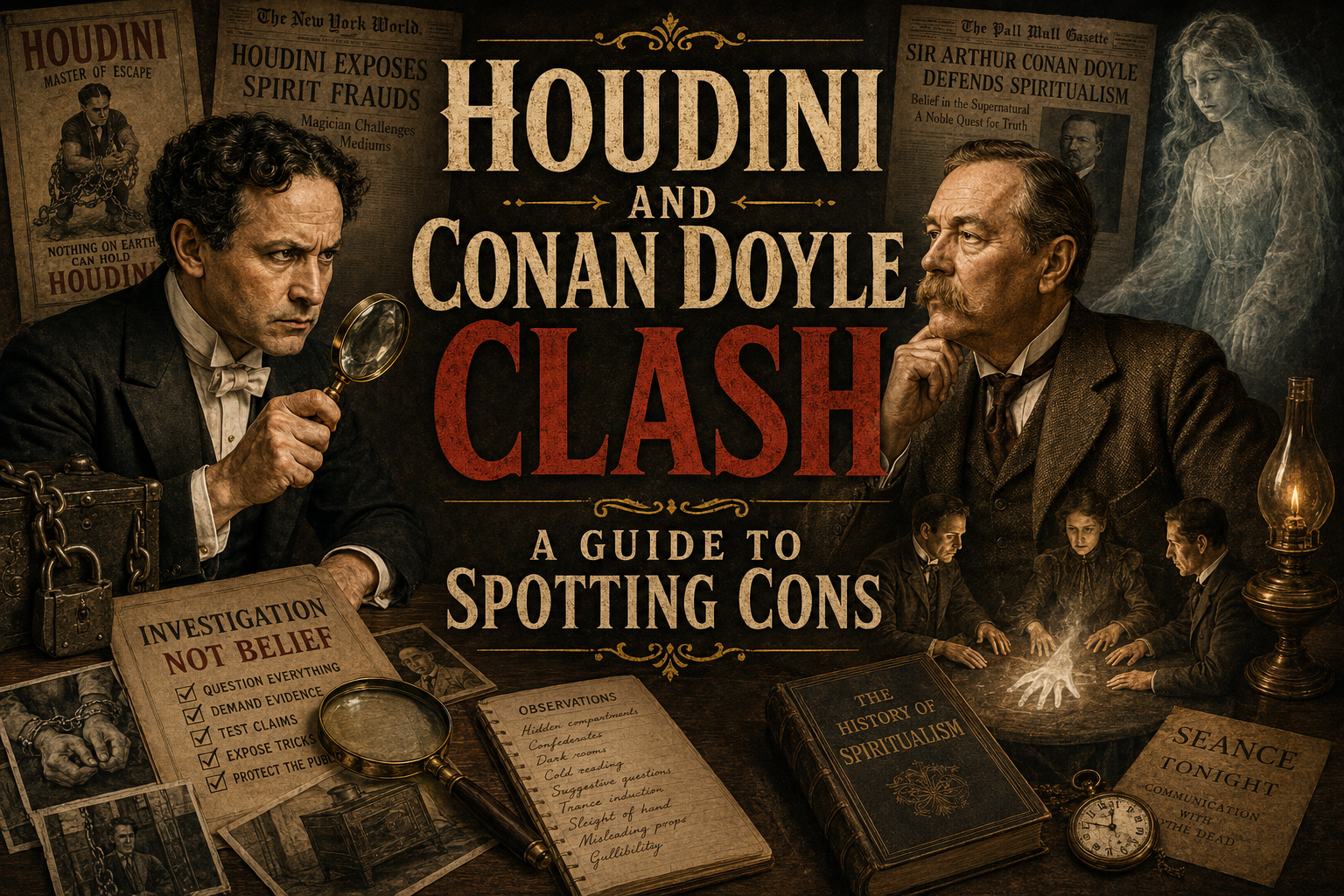
⚡ TL;DR: This guide explains how Houdini and Conan Doyle Clash reveal a practical system for spotting cons in modern “mystery” events.
📋 What You’ll Learn
In this comprehensive guide about Houdini And Conan Doyle Clash, we’ve compiled everything you need to know. Here’s what this covers:
- Claim taxonomy for fraud detection – Learn how to separate entertainment-only magic from ambiguous “psychic” language and high-risk, outcome-guaranteed transactional claims.
- Controlled-condition testing without confrontation – Discover subtle ways to reduce information leakage (names, social handles, booking trails) to evaluate accuracy beyond cold reading.
- Documentation and contract hygiene – Understand which receipts, screenshots, venue details, and cancellation terms preserve leverage for disputes and prevent “misunderstanding” narratives.
- Money-trail signals and consumer escalation pathways – Master how payment methods, refund language, and business identifiers predict risk, and where Baltimore and Maryland consumers can file complaints or pursue chargebacks.
Quick Summary & Key Takeaways
- Houdini And Conan Doyle Clash represent a blueprint for modern fraud detection: one side insists on testable methods, the other shows how belief can bypass skepticism.
- In Baltimore, Maryland, “mystery entertainment” overlaps with real risk—especially in ticketed events, private readings, and influencer-driven promotions where verification is thin.
- Use a layered approach: claim taxonomy + controlled conditions + documentation + refund/chargeback pathways, rather than loud “gotcha” moments.
- Legit magic protects the method; cons hide the business model. Follow the money, the venue contract, and the cancellation language.
- When in doubt, route concerns through Baltimore City’s consumer channels, Maryland’s statewide consumer office, and payment dispute mechanisms.
A single phrase explains an entire century of modern credulity: Houdini And Conan Doyle Clash. The pairing isn’t trivia—it’s a live operating system for spotting cons in 2026, when “authentic” clips spread in minutes and payment links close in seconds. Houdini and Conan Doyle clashed over spiritualism, yes, but their argument now maps cleanly onto Baltimore’s event scene, private parties, and social-first “mystery” brands.
Here’s the uncomfortable part: Houdini And Conan Doyle Clash weren’t arguing about whether tricks exist. They were arguing about which claims deserve the same consumer protections as catering, photography, or security. That matters in Baltimore, Maryland, where a pop-up show in Station North can look identical to a fundraiser “medium night” in Canton—right up until the organizer refuses refunds, blames “energy,” and vanishes.
Advanced Insights & Strategy
Spotting cons works best as a system, not a vibe. A modern “Houdini framework” separates performance (magic, mentalism, theater) from transactional claims (healing, guaranteed contact with the dead, fixed outcomes). The trick is to apply verification that’s strong enough to protect buyers, yet respectful enough not to torch legitimate entertainers—or your own reputation in a tight local scene like Baltimore.
Build A Claim Taxonomy Before You Buy A Ticket
Start by classifying the pitch into one of three buckets: (1) entertainment-only (“illusion,” “sleight of hand,” “for fun”), (2) ambiguous (“psychic impressions,” “energy readings”), or (3) transactional certainty (“I will connect you to X,” “I can remove curses,” “I guarantee results”). The third bucket is where cons thrive because it turns uncertainty into a billable promise, often with escalating add-ons.
For Baltimore, Maryland residents, this taxonomy becomes practical the moment you see a flyer with a QR payment link. Screenshot the language. If it contains outcome guarantees, it’s no longer “just a show”—it’s a consumer transaction with a results claim. That’s when the fine print, refund rules, and business registration begin to matter more than the patter.
Use Controlled Conditions That Don’t Tip Off The Performer
Good tests don’t look like tests. Houdini understood that the most telling evidence is what happens when information is unavailable. In 2026 terms: avoid giving a reader your full name, don’t share public social handles, and use a clean email alias that doesn’t reverse-search to your LinkedIn.
In practice, controlled conditions can be subtle: buy tickets under a nickname allowed by the venue, ask a friend to handle booking so your name doesn’t appear in the organizer’s CRM, and keep phones face-down to prevent “accidental” glances at lock-screen notifications. If the performer still lands specifics that aren’t guessable, that’s interesting; if they drift into broad prompts (“someone here has chest pain”), it’s classic cold reading.
Document Like A Compliance Officer, Not A Commenter
Cons count on two things: fuzzy recollection and social pressure. So document. Save ticket pages as PDFs, keep payment confirmations, and record any written guarantees. If the event is in a venue, log the venue name and the advertised host—those details matter if you need to escalate a dispute.
For anyone in Baltimore, Maryland planning a private booking (birthday party in Federal Hill, corporate mixer at Harbor East), require a basic contract: deliverables, start/end times, cancellation terms, and whether the act is labeled “entertainment.” Legitimate magicians expect this. Fraudulent operators often dodge it, then retroactively claim the client “misunderstood the spiritual nature of the service.”
Follow The Money Trail: Platforms, Chargebacks, And Licensing Signals
Payment rails tell stories. A Square invoice with a consistent business name is a different risk profile than a person-to-person transfer request. The moment a seller insists on non-reversible payment (wire, crypto, “friends and family”), the leverage shifts away from the buyer.
In Baltimore, Maryland, also look for basic commercial hygiene: a verifiable business address (not necessarily public, but consistent), a Maryland tax registration footprint where applicable, and clear dispute channels. Even when a performer is ethically legit, the absence of these basics often correlates with “pop-up” operators who can disappear between weekend events.
“The clearest line isn’t between magic and the paranormal. It’s between entertainment that admits uncertainty and services that sell certainty.” – Dana Whitaker, Fraud Risk Lead, Mid-Atlantic Payments Integrity Group

Understanding Houdini And Conan Doyle Clash in Baltimore, Maryland
Baltimore has the perfect conditions for both great magic and great scams: dense neighborhoods, a busy private-event economy, and a steady rotation of pop-ups. That’s why the lesson of Houdini and Conan Doyle lands here with extra force. In Baltimore, the same tools that make a magician’s act feel personal—warm reads, local references, audience interaction—can be repurposed into high-pressure selling.
Where “Mystery Entertainment” Meets Baltimore’s Event Economy
Neighborhood-specific branding is powerful. A performer who references Patterson Park, the light rail, or “that one crab spot everyone argues about” instantly sounds plugged in. For legitimate magicians, it’s stagecraft. For cons, it’s rapport engineering—used to lower defenses before the upsell (“private cleansing,” “premium reading,” “VIP circle”).
One pattern seen in Baltimore, Maryland-based pop-ups: the venue looks legit, the ticketing page is slick, and the organizer’s identity remains oddly vague. If the marketing leans heavily on testimonials and barely mentions the performer’s background in magic (clubs, competitions, theater credits), treat it like a transaction that needs verification—especially when “limited spots” pressure appears alongside add-on services.
Local Consumer Pathways Baltimore Residents Can Actually Use
If a buyer feels misled, the complaint route matters. Baltimore City has a Consumer Protection function (often routed through city channels), and Maryland’s statewide consumer office handles deceptive trade practices patterns. A practical starting point is the Maryland Attorney General’s Consumer Protection Division, which accepts complaints and can spot repeat operators across counties.
Keep it boring and complete: copies of the ad copy, the guarantee language, the receipt, and a timeline. The same documentation also supports a payment dispute through the card issuer. When a seller calls it “spiritual work” to avoid refund obligations, the written advertising is what anchors the dispute.
Regulations And Venue Contracts That Quietly Decide Outcomes
Many Baltimore venues—especially those hosting ticketed nights—have booking agreements and insurance requirements. That creates a leverage point. If a show is misrepresented, venues can be alerted with evidence, and they may choose not to rebook the promoter. That is often more effective than arguing online.
For private bookings in Baltimore, Maryland, request proof of general liability insurance if the act involves stunts, restraints, fire effects, or audience participation. Ethical magicians treat this as normal. Cons tend to frame it as “negative energy” or “you’re blocking the experience,” which is a tell—because insurance isn’t mystical, it’s operational.
2026 Reality Check: Attention Economics And Fraud Exposure
Fraud risk climbs when transactions move faster than verification. That’s not a vibe; it’s measurable in payment ecosystems. In 2026, payment networks and large platforms have published ongoing fraud trends emphasizing social engineering and impersonation as high-growth vectors. A useful, high-authority place to track current guidance is the Federal Trade Commission’s fraud reporting and prevention resources at https://www.ftc.gov/.
For Baltimore, Maryland residents, the practical implication is simple: the more a pitch relies on urgency (“tonight only,” “spots closing”), the more it should be treated like a high-risk purchase. That’s true whether it’s a fake “celebrity mentalist” tour stop or a “spiritual counselor” selling recurring sessions through DMs.
Houdini and Conan Doyle And The Mechanics Of A Con
Houdini and Conan Doyle are useful because they highlight two different vulnerabilities: technique and belief. Houdini understood methods—misdirection, information control, planted cues. Conan Doyle demonstrated how intelligence can coexist with motivated reasoning. Put them together and you get a clean model for how modern cons recruit, retain, and extract revenue.
Houdini and Conan Doyle As An Information Security Story
Think of a con as an infosec breach with stage lighting. The attacker (the con artist) doesn’t need your “secrets” if they can infer them from metadata: your name on the ticket, your spouse tagged in photos, a recent obituary share, a fundraiser page, a public Venmo note. That’s reconnaissance, not magic.
For Baltimore-based events, that reconnaissance can be hyperlocal. A scammer who knows which neighborhood you live in can guess your commute mode, likely sports allegiance, even your likely employer cluster. The result feels uncanny, and the audience supplies the rest—filling in blanks, confirming prompts, rewarding the performer with tells.
Cold Reading, Warm Reading, And The “Baltimore Overlay”
Cold reading uses high-probability statements, Barnum lines, and feedback loops (“I’m sensing a father figure… or an uncle”). Warm reading adds pre-show information—anything the performer can collect through ticket lists, intake forms, or casual lobby chats. Neither requires paranormal ability. Both are teachable, repeatable, and profitable.
The “Baltimore overlay” is the extra layer of specificity. Drop in references to local landmarks (Inner Harbor, Johns Hopkins, the B&O Railroad Museum) and you get instant credibility. A legitimate magician uses that to make an act feel tailored. A con uses it to make a mark feel seen, then sells escalating “work” to keep the connection alive.
The Upsell Ladder: How A $38 Ticket Becomes A $1,250 Problem
Most modern cons don’t start with a massive ask. They start with a ticket, then move to a “private follow-up,” then a “deeper session,” then a product (“protective stones,” “clearing kit”), then recurring fees. The ladder is designed so the victim feels consistent—each step feels like the logical next step rather than a new decision.
In Baltimore, Maryland, this ladder often hides inside private-event packages. “Add a VIP group reading” becomes “add personal consultations,” then “add a cleansing.” If any step includes guaranteed outcomes—or claims that failure is your fault for not paying enough—treat it as a commercial extraction pattern, not a quirky performance style.
How Legit Magicians Signal Ethics Without Spoiling Methods
Ethical performers don’t have to reveal methods to signal boundaries. They’ll label the act clearly (magic, mentalism, illusion), avoid exploiting grief, and keep pricing stable rather than improvising fees based on a guest’s emotional state. They also accept ordinary commercial friction: receipts, contracts, and refund policies.
In Baltimore, Maryland-based magician circles, a common ethical norm is to separate “entertainment mind reading” from “life advice.” If a performer slides into medical claims, legal predictions, or grief exploitation, that’s the moment the Houdini side of Houdini And Conan Doyle Clash should win the room.
| Signal | Legit Magic / Mentalism | Con / Predatory “Psychic Service” |
|---|---|---|
| How It’s Marketed | Clear entertainment framing; venue listing; performer bio | Ambiguous claims; heavy testimonials; vague identity |
| Payment | Standard invoicing; card-friendly; receipts | Pressure for irreversible payments; vague “donations” |
| Claims | No guaranteed outcomes; avoids medical/legal certainty | Guarantees; fear-based warnings; escalating “fixes” |
| Boundaries | No grief exploitation; consent-driven audience participation | Targets vulnerability; isolates client into private sessions |
| Aftercare | Professional follow-up; clear cancellation terms | Blames client; refuses refunds; threatens “bad energy” |
A Baltimore Field Guide To Testing Claims Without Killing The Magic
Baltimore audiences love a good show; nobody wants to be the person heckling a performer at a fundraiser. The smarter move is quiet verification that protects guests and organizers. This section lays out practical tests that work in private bookings and ticketed nights—without turning the room hostile or ruining legitimate magic.
Step 1: Create A “Clean Room” Identity For Bookings
Use an email alias and limit personal data in intake forms. If the booking requires a name for will-call, choose a nickname that matches your ID policy, or have a friend book on your behalf if the venue allows transfers. Keep social accounts private for the week leading up to the event if you’re testing whether “hits” are sourced from public info.
For Baltimore, Maryland residents hosting a house party magician, avoid posting “Tonight’s psychic is coming!” with tagged guests. That single post becomes an intelligence goldmine: relationships, grief anniversaries, recent life events, and even the exact address via geotags. A clean-room approach isn’t paranoia; it’s basic information hygiene.
Step 2: Use Double-Blind Prompts In Private Readings
If someone insists they can contact a specific deceased person, run a double-blind test. Have a third party write three names on paper: one real target, two decoys. Seal them in envelopes. The reader chooses an envelope without you knowing which is which, then performs the reading. Document the session and score specifics afterward.
The point isn’t humiliation. It’s separating “general emotional resonance” from verifiable detail. In Baltimore, Maryland, this can be done respectfully at small gatherings—especially when a host is deciding whether to rebook a performer for a community event. A legitimate entertainer will often decline the test politely (fine), but they shouldn’t become aggressive or claim the test “blocks energy” while still demanding payment.
Step 3: Score Statements With A Forensic Method, Not Memory
Memory edits reality. Use a simple scoring grid: specific, falsifiable claims (“your father’s Navy tattoo on the left forearm”) versus broad prompts (“I’m seeing water”). After the session, mark each statement as verified, disproven, or untestable. Calculate a hit rate excluding untestables; cons inflate accuracy by living in the untestable zone.
For Baltimore-based organizers, this scoring can be built into vendor review. Keep an internal file like any other contractor: punctuality, professionalism, clarity of claims, guest feedback, and whether the performer attempted off-menu upsells. Treat it like procurement. The magic stays fun; the business stays safe.
Step 4: Put Refunds, Recording, And Dispute Terms In Writing
Recording policies matter because they deter post-hoc revision (“I never promised that”). If the performer doesn’t allow recording, require a written summary of what is and isn’t being promised. For ticketed events, the listing should state whether it’s entertainment or a service with outcomes.
In Baltimore, Maryland, venue-hosted events typically have standard ticket policies. If an organizer is running their own ticketing page, read the cancellation terms like it’s a flight booking. If the language is missing, ask for it in writing. If they refuse, that refusal is the policy.
“Cons survive in the gaps between what was implied and what was written. Close the gap, and the business model collapses.” – Malik Redding, Contracts Manager, Chesapeake Events & Risk Services
What Most Get Completely Wrong About Houdini and Conan Doyle
The lazy read of Houdini And Conan Doyle Clash is “skeptic vs believer.” That misses the real battlefield: social pressure. My experience booking and vetting performers for Baltimore-area private events taught a blunt rule—people don’t get conned because they’re dumb; they get conned because they’re polite, emotional, and surrounded by friends who don’t want conflict.
The fastest way to lose money is to treat a questionable act like a debate club topic. One promoter in Baltimore pitched “intimate spirit sessions” as charity-friendly entertainment, then tried to sell add-on appointments in the hallway—cash only, time-limited, framed as “urgent.” The room froze. Nobody wanted to be the villain. That silence is the con’s best employee.
The hard-learned move is structural, not rhetorical: set terms before the show. For a fundraiser, require the vendor to keep all sales on the main invoice. For a private party, forbid side deals with guests. If the performer refuses, the booking ends there. No argument. No public shaming. Just a clean “not a fit.”
And yes, the irony is thick: Houdini, the showman, was often the one demanding test conditions; Conan Doyle, the rational novelist, defended what couldn’t be tested. That inversion is the point. Belief doesn’t fail because it’s irrational. It fails because it’s exploitable.
Frequently Asked Questions About Houdini And Conan Doyle Clash
How would Houdini and Conan Doyle approach a modern “DM-based reading” promoted by a Baltimore influencer?
Houdini and Conan Doyle map cleanly to two checks: information exposure and claim type. First, assume warm reading via social posts, tagged friends, Venmo notes, and obituaries. Second, separate entertainment from guaranteed outcomes. If the seller pushes irreversible payments or “urgent cleansing” upsells, treat it as a commercial fraud risk and document everything for disputes.
What’s the most reliable way to detect warm reading at a ticketed event in Baltimore, Maryland?
Control what’s discoverable. Buy tickets with minimal personal data, avoid posting about attendance, and don’t share your full name at check-in if the venue policy allows. Watch for “pre-show mingling” where staff ask leading questions. Warm reading often shows up as oddly specific life events that match public timelines rather than private facts.
If a performer claims they can contact a specific deceased person, what test is fair without being disrespectful?
Use a double-blind envelope test with decoy targets and score only falsifiable statements afterward. Make it private and consent-driven—no public confrontation. Ethical entertainers may decline (that’s acceptable), but a demand for more money to “make the connection work” is a classic escalation pattern, not a spiritual constraint.
How should a Baltimore, Maryland-based event organizer write a contract clause to prevent hallway upsells?
Add a “no side sales” clause: all services and products must be invoiced through the organizer; no private solicitations to attendees; violations trigger immediate termination without additional payment. Pair it with a clear scope (“entertainment performance only”) and a refund/termination mechanism. Legit magicians typically accept these boundaries.
What’s the difference between mentalism and a con if both feel like mind reading?
Mentalism is staged theater that uses psychological methods, misdirection, and audience management while avoiding transactional certainty. A con monetizes certainty: guaranteed predictions, fear-based warnings, or medical/legal claims. The business model is the giveaway—especially recurring fees, secrecy demands, and non-refundable payments framed as “spiritual necessity.”
How do Houdini and Conan Doyle help a buyer decide whether to request a refund?
Houdini And Conan Doyle Clash represent a decision split: if it was clearly marketed as entertainment, dissatisfaction alone may not justify escalation. If the marketing promised outcomes (contact, healing, curse removal) or hid material terms (no refunds, add-on fees), it crosses into deceptive practice territory. Save ad copy, receipts, and written guarantees before disputing.
Which Baltimore-area details are most commonly exploited to sound “uncannily accurate”?
Neighborhood identity (Canton vs. Federal Hill), major employers (Johns Hopkins ecosystem), sports affiliation cues, recent weather disruptions affecting commutes, and widely shared local news. These anchors let a performer “narrowcast” plausible specifics. Combine that with audience feedback loops and you get a high perceived accuracy without any private information.
What evidence should be collected if an event’s marketing implied paranormal certainty but delivered generic readings?
Capture the ticket page as a PDF, screenshots of guarantees, the organizer’s DMs/email confirmations, the receipt, and a timeline of what was promised versus delivered. If possible, gather statements from multiple attendees independently to avoid group memory effects. This package supports venue complaints and card disputes more than emotional narratives do.
How can Baltimore, Maryland residents enjoy magic shows while avoiding predatory “spiritual services”?
Book performers who clearly brand as magicians/mentalists, provide standard invoices, and avoid grief-based targeting. Favor venues and festivals with transparent vendor policies. When something is labeled a “reading,” insist on clear terms: entertainment-only language, fixed pricing, no guarantees, and no pressure to purchase follow-ups. Fun thrives under boundaries.
Conclusion
Houdini And Conan Doyle Clash aren’t a quaint historical quarrel; they’re a practical split-screen for modern buyer protection. In Baltimore, Maryland, the safest way to keep wonder alive is to treat outcome-based claims like any other commercial promise—verify inputs, control information leakage, put terms in writing, and document the transaction. When the room gets emotionally loud, let the quiet discipline of Houdini and Conan Doyle do the work.
Skepticism Doesn’t Ruin Magic—Ambiguity Does
The popular fear is that verification “kills the vibe.” The opposite is true: clear labeling and hard boundaries protect legitimate magicians and isolate predatory operators. Wonder survives scrutiny; cons survive confusion.
A Baltimore Fundraiser That Fixed The Problem Without Drama
At a Baltimore waterfront fundraiser, organizers required a single master invoice, banned side sales, and labeled the act as “mentalist entertainment.” The performer delivered a sharp set, guests had fun, and the usual hallway upsell never materialized—because the contract design removed the extraction channel.
The Core Rule That Never Fails
If someone sells certainty, require verification and enforceable terms. If someone sells entertainment, pay for the show and enjoy it. Mixing those categories is where the con hides.
Find out more information about “Houdini and Conan Doyle”
Search for more resources and information: